In October, Josiah and I traveled through Senegal, Mali, and Guinea. It was a great trip, overall, but not everythin g went as smoothly as planned. There were more than a handful of situations which tested our patience and tempers. Luckily, we turned out to be good travel partners. When we found ourselves extremely bored or anxious about something, Josiah kept us laughing with his unending reserve of poor jokes, random theoretical questions, or funny stories. Josiah combated the boring and tedious with witty and funny stuff. I kept us occupied with discussions of life, love, and spirituality. Between the two of us, we were able to stay sane through our more trying moments. We also found amusement in keeping a tally of various aspects of our trip. Here are some of the numbers from our tally. (keep in mind, this was over a period of only 11 days).
Number of different currencies we used: 4
Number of international borders crossed: 5
Number of attempted bribes: 3
Number of encounters with aggressive officers carrying guns: 3
Number of times Kristy had to prevent Josiah from getting arrested: 3
Number of different types of public transport vehicles taken: 7
Number of hours spent waiting for transport: 57
Number of hours spent actually traveling: 78
Total number of travel hours: 135
Number of times we had to say “I don’t speak French. A nani Pulaar?” (“Do you speak Pulaar?”):
 g went as smoothly as planned. There were more than a handful of situations which tested our patience and tempers. Luckily, we turned out to be good travel partners. When we found ourselves extremely bored or anxious about something, Josiah kept us laughing with his unending reserve of poor jokes, random theoretical questions, or funny stories. Josiah combated the boring and tedious with witty and funny stuff. I kept us occupied with discussions of life, love, and spirituality. Between the two of us, we were able to stay sane through our more trying moments. We also found amusement in keeping a tally of various aspects of our trip. Here are some of the numbers from our tally. (keep in mind, this was over a period of only 11 days).
Number of different currencies we used: 4
Number of international borders crossed: 5
Number of attempted bribes: 3
Number of encounters with aggressive officers carrying guns: 3
Number of times Kristy had to prevent Josiah from getting arrested: 3
Number of different types of public transport vehicles taken: 7
Number of hours spent waiting for transport: 57
Number of hours spent actually traveling: 78
Total number of travel hours: 135
Number of times we had to say “I don’t speak French. A nani Pulaar?” (“Do you speak Pulaar?”):
approximately 20 times a day
Number of cups of coffee consumed (each): 28
Number of times we ate meals consisting of a combination of beef and egg: at least once a day
Number of cans of tuna we hauled along on the trip and consumed: 20
Number of salads consumed: 1 (each)
Number of times we were called “toubab”: 10 times, and all within the final 8 hours of the trip
Number of kilometers hiked through the beautiful forests of Guinea: 24
Number of open soars on Kristy’s feet after the 18km hike: 10
Number of stressful situations that occurred in Guinea (excluding travel situations): 0
Josiah and I think these numbers speak for themselves, but for those who would like a little further explanation, here is the story our adventure…
The logical place to begin a trip east from The Gambia is from the bustling “city” of Basse, which has a large car garage with vehicles traveling to all major towns in Senegal and surrounding countries on most days of the week. The logical choice, however, was not the way we decided to go. If you look on a map, my village- Fatoto- is far closer to Tamaba Kounda (the first major town we would be traveling through) than Basse. Leaving from Basse would have meant traveling west from Fatoto to Basse, then back east again to Tamba. Besides, Josiah wanted to come visit my village for a few days before the trip. So we decided to take a “short cut” to Tamba from Fatoto.
The only problem with leaving from Fatoto was figuring out how we would get to Senegal. I am less than 15km from the eastern border of The Gambia and Senegal, but transport East from Fatoto is practically non-existent. My brother, Samba, told me about these tractors, which pick up bags of sugar in the Fatoto market and transport them to the border town, Picadus, in Senegal (sugar in Senegal is much more expensive than in The Gambia so they smuggle it across the border, then sell it for a profit). Samba assured me that the sugar tractors ran every day. So that was our plan… to hitch a ride on a sugar tractor to the border, and catch public transport from there. (I have to throw in a cheesy pun here. When I told my site-mate, Ian, about our plans to ride with the sugar tractor, he said “That should be a sweet ride!” ha ha.)
Due to the fact that we live in Africa, and should never have counted on something which happens consistently every day to happen on the day we want it to… we discovered the day before we were planning to depart for our trip that there was a good chance that no sugar tractor would be leaving the next day. They had hauled too many bags the day before, and probably wouldn’t have a full load to haul the following day. So we had to devise another form of transport. We considered walking it. But 13km with our large packs seemed a little ambitious. I spoke with one of my friends, Cherno, about hiring his donkey cart to give us a ride. He said he would be happy to let us use the donkey cart, but his donkey was pregnant, and could not make the journey. So then we asked a second man, Omar, if we could hire his donkey to use with Cherno’s cart. He agreed, so now we began negotiating the price. Negotiating and bargaining are the way things work here, but it can get tricky – especially when you have to negotiate with 2 people for the same service. After about an hour of negotiations, we came to an agreement and paid our money. They told us to come at 6:30 in the morning and we would leave.
The next morning, the donkey cart was only an hour late (not a bad wait for transport in Africa). Our “chauffeurs” were the two adolescent sons of Omar, the owner of the donkey. The road was very bad. In fact, it’s difficult to even call it a road in some places. Needless to say, it was a bumpy ride, and I felt lucky that I only fell off of the cart once. When we weren’t holding on for dear life, we were enjoying the scenery. We passed through villages and areas of The Gambia that most people never see. We felt the donkey cart ride was an appropriate way to begin our trip (thus began the tally of number of different types of public transport vehicles we used).
From Picadus, we caught a ride with a Gile Gile going to Tamba. Here, we were excited to find a restaurant that served hamburgers (hamburgers are a delicacy for us). The waitress asked if we wanted hamburgers or a king burgers. We had to laugh. The answer was obvious. “Bring us King Burgers, of course.” A king burger is a hamburger served French-style: two hamburger patties with a fried egg on top. Senegal is one of the many West African countries previously colonized by the French. Therefore, the main language spoken in Senegal is French, the currency is the CFA (Central African Franc), and much of the culture (including the food) has a French influence as well. Hence, the King Burger. We were so impressed by our King Burgers in Tamba, and we knew that all of the countries we would be traveling through are French-speaking countries, so we decided to make it a goal to eat as many king burgers as possible on this trip. (Thus, the beginning of another tally: number of king burgers or other combinations of beef and egg eaten on the trip). Obviously, nutrition was not a huge priority for us. This was our vacation. Bring on the king burgers.
After gorging ourselves on King Burgers, we found a bar that was playing the big football game between The Gambia and Senegal. (Just a side note here- by “football,” I’m talking about the game that everyone in the world besides Americans call football… not the US version of football, which involves very little contact between the foot and the ball). This was an important game for both Gambians and Senegalese, since they have traditionally been huge rivals. We sat in the very back and quietly rooted for The Gambia. Luckily, we left before the end of the game, which ended in a tie score between the two countries, knocking Senegal out of the play-offs and causing riots throughout the country.
The next day, we left Tamba, headed to the town of Kadira, which lies on the border between Senegal and Mali, and boarded a large bus for Bamako (the capital of Mali). At the border, we encountered our first aggressive officer with a gun (the first of yet another tally). He was the immigration officer. It seems that the basic role of an immigration officer is to collect all the passports and ID cards of the passengers in a vehicle and inspect them for authenticity and/or the presence of visas, if required. By holding on to everyone’s ID cards, they are able to collect bribes by demanding money in exchange for the return of your passport or ID card. And this guy was determined to get paid. He denied being able to speak any language besides French, which forced us to solicit help from one of the few English-speaking passengers on our bus. He was a nice man who was unfortunate enough to help us by translating for this belligerent officer. What caused the trouble was that we did not have visas for Mali, but this was not our fault. The Malian embassy in The Gambia does not issue visas, and told us that we would be able to buy them at the border. The officer told us our visas would cost 15,000 CFA (about $33) a piece, and we would also have to pay an additional 33,000 CFA each as a “penalty.” After many words were passed through our poor translator, the officer was getting very angry and shouting at all three of us in French. Josiah was loosing his composure, and I was forced to take over negotiations. Eventually, I decided to call the Peace Corps Safety and Security officer in Mali, but when I pulled out the phone to make the call, the officer angrily conceded to giving us our visas for 15,000 CFA a piece and dismissed the “penalty”. Unfortunately, when he realized he would not be able to get his bribe from us, he held the ID card of our “translator,” requiring him to pay 5,000 CFA before getting it back. Upon returning to the bus, we refunded the man’s money. We felt terrible that he was forced to pay simply for helping us.
Due to our delay at the border and several other long stops along the way, we didn’t arrive in Bamako until 3:30 in the morning. After a few hours of sleep, we found our way to the Peace Corps office in Bamako. This was on a Monday morning. One of the things we needed to do in Mali was fill out our ballots for the American elections. The reason why we needed to do this in Mali was because Peace Corps The Gambia had decided that the way they would get all Gambian PCV’s to vote was by sending ballots on October mail-run. They sent a message at the end of September to all PCV’s, stating that we should be at our sites when mail-run arrived so that we could receive the write-in ballots and vote. Mail-run would bring all the ballots back to the capitol, and they would mail them all out together. Unfortunately, Josiah and I would both be traveling when mail run came to our sites in October. I completed and mailed the paperwork for my absentee ballot in April, but had not received it yet. Before the trip, I called the office, searching for any alternative we may have to still be able to vote in the elections. Our office called ahead to the Malian office, and found out that we could vote through them, and they would mail the ballots for us… so that’s what we decided to do.
Unfortunately, we arrived at the office on Columbus Day… Not a holiday celebrated in Africa unless you work for an American institution like the Peace Corps. So the office was closed. We would have to vote on Tuesday. I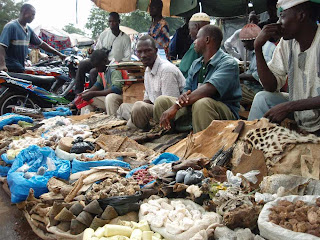 n the meantime, we found a room with the Catholic Mission in Bamako and set out to explore the city. Bamako is huge, busy, and crowded. The streets are packed with traffic and road-side vendors. There was much to do and see. We walked through the immense market, including the “fetish,” or witchcraft market, which consisted of vendors selling all sorts of creepy items: animal heads and bones, a variety of herbs, plants, animal skins, and much more. The street food in Bamako is delicious. I found fried dough patties filled with ground beef and boiled eggs, which I nicknamed “fried king burgers.”
Number of cups of coffee consumed (each): 28
Number of times we ate meals consisting of a combination of beef and egg: at least once a day
Number of cans of tuna we hauled along on the trip and consumed: 20
Number of salads consumed: 1 (each)
Number of times we were called “toubab”: 10 times, and all within the final 8 hours of the trip
Number of kilometers hiked through the beautiful forests of Guinea: 24
Number of open soars on Kristy’s feet after the 18km hike: 10
Number of stressful situations that occurred in Guinea (excluding travel situations): 0
Josiah and I think these numbers speak for themselves, but for those who would like a little further explanation, here is the story our adventure…
The logical place to begin a trip east from The Gambia is from the bustling “city” of Basse, which has a large car garage with vehicles traveling to all major towns in Senegal and surrounding countries on most days of the week. The logical choice, however, was not the way we decided to go. If you look on a map, my village- Fatoto- is far closer to Tamaba Kounda (the first major town we would be traveling through) than Basse. Leaving from Basse would have meant traveling west from Fatoto to Basse, then back east again to Tamba. Besides, Josiah wanted to come visit my village for a few days before the trip. So we decided to take a “short cut” to Tamba from Fatoto.
The only problem with leaving from Fatoto was figuring out how we would get to Senegal. I am less than 15km from the eastern border of The Gambia and Senegal, but transport East from Fatoto is practically non-existent. My brother, Samba, told me about these tractors, which pick up bags of sugar in the Fatoto market and transport them to the border town, Picadus, in Senegal (sugar in Senegal is much more expensive than in The Gambia so they smuggle it across the border, then sell it for a profit). Samba assured me that the sugar tractors ran every day. So that was our plan… to hitch a ride on a sugar tractor to the border, and catch public transport from there. (I have to throw in a cheesy pun here. When I told my site-mate, Ian, about our plans to ride with the sugar tractor, he said “That should be a sweet ride!” ha ha.)
Due to the fact that we live in Africa, and should never have counted on something which happens consistently every day to happen on the day we want it to… we discovered the day before we were planning to depart for our trip that there was a good chance that no sugar tractor would be leaving the next day. They had hauled too many bags the day before, and probably wouldn’t have a full load to haul the following day. So we had to devise another form of transport. We considered walking it. But 13km with our large packs seemed a little ambitious. I spoke with one of my friends, Cherno, about hiring his donkey cart to give us a ride. He said he would be happy to let us use the donkey cart, but his donkey was pregnant, and could not make the journey. So then we asked a second man, Omar, if we could hire his donkey to use with Cherno’s cart. He agreed, so now we began negotiating the price. Negotiating and bargaining are the way things work here, but it can get tricky – especially when you have to negotiate with 2 people for the same service. After about an hour of negotiations, we came to an agreement and paid our money. They told us to come at 6:30 in the morning and we would leave.
The next morning, the donkey cart was only an hour late (not a bad wait for transport in Africa). Our “chauffeurs” were the two adolescent sons of Omar, the owner of the donkey. The road was very bad. In fact, it’s difficult to even call it a road in some places. Needless to say, it was a bumpy ride, and I felt lucky that I only fell off of the cart once. When we weren’t holding on for dear life, we were enjoying the scenery. We passed through villages and areas of The Gambia that most people never see. We felt the donkey cart ride was an appropriate way to begin our trip (thus began the tally of number of different types of public transport vehicles we used).
From Picadus, we caught a ride with a Gile Gile going to Tamba. Here, we were excited to find a restaurant that served hamburgers (hamburgers are a delicacy for us). The waitress asked if we wanted hamburgers or a king burgers. We had to laugh. The answer was obvious. “Bring us King Burgers, of course.” A king burger is a hamburger served French-style: two hamburger patties with a fried egg on top. Senegal is one of the many West African countries previously colonized by the French. Therefore, the main language spoken in Senegal is French, the currency is the CFA (Central African Franc), and much of the culture (including the food) has a French influence as well. Hence, the King Burger. We were so impressed by our King Burgers in Tamba, and we knew that all of the countries we would be traveling through are French-speaking countries, so we decided to make it a goal to eat as many king burgers as possible on this trip. (Thus, the beginning of another tally: number of king burgers or other combinations of beef and egg eaten on the trip). Obviously, nutrition was not a huge priority for us. This was our vacation. Bring on the king burgers.
After gorging ourselves on King Burgers, we found a bar that was playing the big football game between The Gambia and Senegal. (Just a side note here- by “football,” I’m talking about the game that everyone in the world besides Americans call football… not the US version of football, which involves very little contact between the foot and the ball). This was an important game for both Gambians and Senegalese, since they have traditionally been huge rivals. We sat in the very back and quietly rooted for The Gambia. Luckily, we left before the end of the game, which ended in a tie score between the two countries, knocking Senegal out of the play-offs and causing riots throughout the country.
The next day, we left Tamba, headed to the town of Kadira, which lies on the border between Senegal and Mali, and boarded a large bus for Bamako (the capital of Mali). At the border, we encountered our first aggressive officer with a gun (the first of yet another tally). He was the immigration officer. It seems that the basic role of an immigration officer is to collect all the passports and ID cards of the passengers in a vehicle and inspect them for authenticity and/or the presence of visas, if required. By holding on to everyone’s ID cards, they are able to collect bribes by demanding money in exchange for the return of your passport or ID card. And this guy was determined to get paid. He denied being able to speak any language besides French, which forced us to solicit help from one of the few English-speaking passengers on our bus. He was a nice man who was unfortunate enough to help us by translating for this belligerent officer. What caused the trouble was that we did not have visas for Mali, but this was not our fault. The Malian embassy in The Gambia does not issue visas, and told us that we would be able to buy them at the border. The officer told us our visas would cost 15,000 CFA (about $33) a piece, and we would also have to pay an additional 33,000 CFA each as a “penalty.” After many words were passed through our poor translator, the officer was getting very angry and shouting at all three of us in French. Josiah was loosing his composure, and I was forced to take over negotiations. Eventually, I decided to call the Peace Corps Safety and Security officer in Mali, but when I pulled out the phone to make the call, the officer angrily conceded to giving us our visas for 15,000 CFA a piece and dismissed the “penalty”. Unfortunately, when he realized he would not be able to get his bribe from us, he held the ID card of our “translator,” requiring him to pay 5,000 CFA before getting it back. Upon returning to the bus, we refunded the man’s money. We felt terrible that he was forced to pay simply for helping us.
Due to our delay at the border and several other long stops along the way, we didn’t arrive in Bamako until 3:30 in the morning. After a few hours of sleep, we found our way to the Peace Corps office in Bamako. This was on a Monday morning. One of the things we needed to do in Mali was fill out our ballots for the American elections. The reason why we needed to do this in Mali was because Peace Corps The Gambia had decided that the way they would get all Gambian PCV’s to vote was by sending ballots on October mail-run. They sent a message at the end of September to all PCV’s, stating that we should be at our sites when mail-run arrived so that we could receive the write-in ballots and vote. Mail-run would bring all the ballots back to the capitol, and they would mail them all out together. Unfortunately, Josiah and I would both be traveling when mail run came to our sites in October. I completed and mailed the paperwork for my absentee ballot in April, but had not received it yet. Before the trip, I called the office, searching for any alternative we may have to still be able to vote in the elections. Our office called ahead to the Malian office, and found out that we could vote through them, and they would mail the ballots for us… so that’s what we decided to do.
Unfortunately, we arrived at the office on Columbus Day… Not a holiday celebrated in Africa unless you work for an American institution like the Peace Corps. So the office was closed. We would have to vote on Tuesday. I
 n the meantime, we found a room with the Catholic Mission in Bamako and set out to explore the city. Bamako is huge, busy, and crowded. The streets are packed with traffic and road-side vendors. There was much to do and see. We walked through the immense market, including the “fetish,” or witchcraft market, which consisted of vendors selling all sorts of creepy items: animal heads and bones, a variety of herbs, plants, animal skins, and much more. The street food in Bamako is delicious. I found fried dough patties filled with ground beef and boiled eggs, which I nicknamed “fried king burgers.”
One of our favorite places in Bamako was a bar and restaurant called ‘the Apaloosa”. Picture this if you can: The owners are French, the cocktail waitresses are Ukrainian and Malian, and the wait staff are Malian. The owners have a strange affinity for the American West. The place was full of pictures of Native American Indian Chiefs and cowboy paraphernalia, as well as other American pop culture items. There was a large American flag with a picture of Jimi Hendrix printed over the stars. There were American license plates and bumper stickers. Josiah said the walls looked a lot like a TIG Fridays or Chilis. And the best part: the Malian waiters wore complete cowboy ensembles, including cowboy hats.
We enjoyed Bamako, but we struggled with language. The official language in Mali is French, but the dominant native language is Bombara, which is similar to the Gambian language, Mandinka. Both Josiah and I were taught Pulaar, the language of the Fula tribe. Fulas are all over West Africa, and we were lucky enough to find a few in Bamako, but not many. And although we’re both familiar with Mandinka, neither of us speak it well enough for it to help us understand or communicate with Bomaras. In addition, neither of us speak French.
One unfortunate incident occurred while in Bamako: while walking back to our room from the large market, I was taking pictures of the streets of Bamako with my brand new camera. There is so much to see on these streets. We passed a crowded alley full of people shopping and selling goods. I snapped a picture of the alley, which, unfortunately, was right next to a large bank. In front of the bank was a security officer (this is #2 on the aggressive officer with a gun tally)… The man shouted for us to come to him. Looking back on it now, I wish we had just kept walking, but instead, we obeyed and went to him. He was pointing at my camera and shouting at us in French. I may not be able to speak French, but I could understand that he was upset about the picture I had just taken. I was about to turn my camera on to show him that the picture I took was a picture of the market… not a picture of him. At this point, he and second officer both grabbed me by the arms as he tried to pry the camera out of my hands. I was holding onto it tightly. At some point in the chaos, I heard Josiah’s voice in my ear: “Kristy, let go of the camera.” I let go, and the officer took the camera and put it in his pocket. I asked Josiah “Why did you tell me to let go? Now he’s going to keep my camera.” Josiah responded, “Well, you had two men with guns grab you violently and try to take your camera, but you refused to let go of it. I was worried about what they would do next.”
Josiah went to find a phone to call the Peace Corps office while I stayed with the officer, trying my best to communicate with him. After much pleading, we finally went inside the bank to talk to the bank manager, who also could not speak English. Eventually, I did get my camera back, but it was a grueling process. And being a Peace Corps Volunteer is what probably saved the day. In Africa, white skin is a symbol of wealth. Almost everyone believes that being white means being rich. It helps that I can speak one African language and that I have a better-than-average understanding of West African culture. However, I am still white, which makes me a red flag for greedy people looking for money. As often as I’ve found myself trying to reason with people who tell me I am rich, I also can’t help but understand why they believe this. By American standards, I am nothing close to rich ( I live off a few dollars a day), but in comparison to most people here, I am still rich. The camera I was using was a gift from my family. It was probably worth a half a year’s salary to that man. It didn’t justify his aggressive actions, but his ignorance is based on truth.
We enjoyed Bamako, but we struggled with language. The official language in Mali is French, but the dominant native language is Bombara, which is similar to the Gambian language, Mandinka. Both Josiah and I were taught Pulaar, the language of the Fula tribe. Fulas are all over West Africa, and we were lucky enough to find a few in Bamako, but not many. And although we’re both familiar with Mandinka, neither of us speak it well enough for it to help us understand or communicate with Bomaras. In addition, neither of us speak French.
One unfortunate incident occurred while in Bamako: while walking back to our room from the large market, I was taking pictures of the streets of Bamako with my brand new camera. There is so much to see on these streets. We passed a crowded alley full of people shopping and selling goods. I snapped a picture of the alley, which, unfortunately, was right next to a large bank. In front of the bank was a security officer (this is #2 on the aggressive officer with a gun tally)… The man shouted for us to come to him. Looking back on it now, I wish we had just kept walking, but instead, we obeyed and went to him. He was pointing at my camera and shouting at us in French. I may not be able to speak French, but I could understand that he was upset about the picture I had just taken. I was about to turn my camera on to show him that the picture I took was a picture of the market… not a picture of him. At this point, he and second officer both grabbed me by the arms as he tried to pry the camera out of my hands. I was holding onto it tightly. At some point in the chaos, I heard Josiah’s voice in my ear: “Kristy, let go of the camera.” I let go, and the officer took the camera and put it in his pocket. I asked Josiah “Why did you tell me to let go? Now he’s going to keep my camera.” Josiah responded, “Well, you had two men with guns grab you violently and try to take your camera, but you refused to let go of it. I was worried about what they would do next.”
Josiah went to find a phone to call the Peace Corps office while I stayed with the officer, trying my best to communicate with him. After much pleading, we finally went inside the bank to talk to the bank manager, who also could not speak English. Eventually, I did get my camera back, but it was a grueling process. And being a Peace Corps Volunteer is what probably saved the day. In Africa, white skin is a symbol of wealth. Almost everyone believes that being white means being rich. It helps that I can speak one African language and that I have a better-than-average understanding of West African culture. However, I am still white, which makes me a red flag for greedy people looking for money. As often as I’ve found myself trying to reason with people who tell me I am rich, I also can’t help but understand why they believe this. By American standards, I am nothing close to rich ( I live off a few dollars a day), but in comparison to most people here, I am still rich. The camera I was using was a gift from my family. It was probably worth a half a year’s salary to that man. It didn’t justify his aggressive actions, but his ignorance is based on truth.
After this encounter, we decided to cut our trip to Mali short by a day or two. I was ready to head to Guinea, where Fula is a common language, and we would be hiking through forests in the mountains. We arrived at the garase (place for taking public transport) in Bamako at nine in the morning on a Thursday. The way transport works in many places is like this: you join a vehicle, pay for your ticket, then wait until all the seats are full. I've had to wait hours in The Gambia before for one vehicle to fill before we can leave. That's why, in The Gambia, I often travel in a vehicle called a "set-plas," which is a french word borrowed from the Senegalese, meaning "seven seats." These are what we would call a station wagon in the states. In a set-plas, one person sits in the passenger seat next to the driver, three in the middle, and three in the back. These vehicles are more expensive than the common Gile Gile, but they fill faster and make fewer stops, making them ideal for traveling longer distances. In The Gambia and Senegal, drivers are penalized if it is discovered that they have more than seven people in one of these vehicles. Hence, the "set-plas" part of it.
In Guinea, however, the roads are too poor for larger vehicles like Gile Gile's and Busses. So the "set-plas" is the primary means of transport. But they have no regulations for how many people can be seated inside of one. So Guinean drivers typically squeeze about 9 inside: 2 in the front seat, 4 in the middle, and 3 in the back. Then they allow other passengers to ride on top of the vehicle. So it was one of these vechicles that we were taking to Guinea. Josiah and I were numbers 4 and 5. We still had 4 passengers left before we could leave. So we waited, and we waited, and we waited. It's amazing how time seems to have a different quality to it when you are just waiting around. I made friends with a nice Fula lady who was selling food in the garase. I sat with her all day long and watched her fry up pieces of plantains, sweet potatoes and potatoes. Josiah wandered most of the day. Sometimes he would sit in the car. Sometimes he would join me and my new friend, Fatoumata. Sometimes he just wandered around. He became particularly attached to the senile old lady in our vehicle that we nicknamed "crazy," after we found her talking to her reflection in the car window. Josiah and Crazy would sit in the car together and share food... she would pass him peices of oranges, and he would bring her some of the fried plantains that Fatoumata had cooked. After waiting for 10 hours (at this point, it's dark outside), the driver told us we would have to come back in the morning. We found a hotel room, slept a few hours, and returned early the next morning.
Our car finally left at 8:30... we were excited to be moving on. At the border of Mali and Guinea, we encountered our third agressive officer with a gun. Actually, he was quite calm compared to our first two, but was still requiring us to give him a bribe. I called the Peace Corps Saftey and Security Officer in Guinea, and handed the phone over to the immigration officer... Yet another incident where it was good to be a Peace Corps Volunteer.
After traveling for 21 hours, we arrived in the town of Pita, where we stayed for one day and one night. Josiah slept for most of the day, while I walked around town and into the market. Pita is a large town surrounded by mountains and rivers. The weather was cool and sunny. The people were almost all Fulas... so I could actually talk to them. The food was delicious, and cheep. I ate a lot of local fruit. Oranges, guavas and a strange-looking fruit the locals called sop-sop.
The next day, w e took transport to the small village of Douke, where a man name Hassan Bah (a Fula), runs a sort of eco-lodge experience. "Eco" in the sense that you live in a hut, use a guest house, and bathe outside (This is really no different from how I live in village regularly, so it was kind of like being "home"). Then, either Hassan or his brother Abdoulie, take the guests on hiking tours through the forests to see amazing rock formations, cliffs, valleys, and waterfalls. They also provide all of your meals. We only stayed for 2 days, but I wish we could have stayed longer. The scenery was amazing. The weather was beautiful. It was exactly what I needed after our hectic travels through Mali.
 e took transport to the small village of Douke, where a man name Hassan Bah (a Fula), runs a sort of eco-lodge experience. "Eco" in the sense that you live in a hut, use a guest house, and bathe outside (This is really no different from how I live in village regularly, so it was kind of like being "home"). Then, either Hassan or his brother Abdoulie, take the guests on hiking tours through the forests to see amazing rock formations, cliffs, valleys, and waterfalls. They also provide all of your meals. We only stayed for 2 days, but I wish we could have stayed longer. The scenery was amazing. The weather was beautiful. It was exactly what I needed after our hectic travels through Mali.
We went on a nice, easy hike our first day there. On the second day, Abdoulie took us for a strenuous 18km hike that they have named "Chutes and Ladders." The first 10 -12 km of the hike is all down-hill through high grasses, rocky paths and overgrown trails. It was beautiful, but I couldn't help thinking "We're still going down. We'll have to begin going up at some point." We stopped for lunch by a waterfall before beginning our upward journey, and it's a good thing we did, because we really needed all the energy we could find. This was the part that earned the hike the title of "Chutes and Ladders." We were essentially climbing up a steep canyon wall. In some places, we used a steep and rocky path, but in other places, we had to climb ladders. The ladders are locally constructed from thick tree branches and peices of bark. They were very sturdy, but slippery in places. In some instances, the ladders were positioned right next to waterfalls, which provided a steady mist of water, making the wood slippery. I lost count of the number of ladders we climbed... perhaps 20? And the "trails" we used in between the ladders were just as challenging (continuously steep and slippery in places). I'm thankful that I managed to keep
 my balance. Josiah called the trail the "stair master." It never really flattened out until we were finished with our hike. We just climbed straight up for 8 km. I was wearing my new Chaoco hiking sandals, which still need some more "breaking-in." By the end of the hike, I counted 10 open cuts and blisters on my feet. As exhausted and soar as we were after finishing the hike, it was by far my favorite part of our trip. And here's an amazing fact: that path we hiked on is a main route for locals traveling between the villages on top of the canyon and in the valley below. The women climb those slippery ladders in flip-flops and with loads on their heads!
 hike our first day there. On the second day, Abdoulie took us for a strenuous 18km hike that they have named "Chutes and Ladders." The first 10 -12 km of the hike is all down-hill through high grasses, rocky paths and overgrown trails. It was beautiful, but I couldn't help thinking "We're still going down. We'll have to begin going up at some point." We stopped for lunch by a waterfall before beginning our upward journey, and it's a good thing we did, because we really needed all the energy we could find. This was the part that earned the hike the title of "Chutes and Ladders." We were essentially climbing up a steep canyon wall. In some places, we used a steep and rocky path, but in other places, we had to climb ladders. The ladders are locally constructed from thick tree branches and peices of bark. They were very sturdy, but slippery in places. In some instances, the ladders were positioned right next to waterfalls, which provided a steady mist of water, making the wood slippery. I lost count of the number of ladders we climbed... perhaps 20? And the "trails" we used in between the ladders were just as challenging (continuously steep and slippery in places). I'm thankful that I managed to keep
 my balance. Josiah called the trail the "stair master." It never really flattened out until we were finished with our hike. We just climbed straight up for 8 km. I was wearing my new Chaoco hiking sandals, which still need some more "breaking-in." By the end of the hike, I counted 10 open cuts and blisters on my feet. As exhausted and soar as we were after finishing the hike, it was by far my favorite part of our trip. And here's an amazing fact: that path we hiked on is a main route for locals traveling between the villages on top of the canyon and in the valley below. The women climb those slippery ladders in flip-flops and with loads on their heads!
After 2 days in Douke, we said farewell to Hassan and his family and headed to Labe, a crowded town with a busy market place. We walked around the town, bought some fruit from the market, ate some good food (including more king burgers), drank coffee and good beer, and found a cheep but clean place to stay the night. The next day, we decided to begin our journey back to The Gambia. This time, we headed to the car park fully prepared to wait a while, even stay an extra night if we needed to. After waiting for 11 hours, we were told there would be no cars leaving directly for Basse (possibly for several days), so we joined a vehicle going to Senegal. Once again, it was 10 people crammed into a station wagon. They told us we would have to share the front passenger seat. Thus began the most physically uncomfortable, sleep-deprived, 21 hour journey of my life. Looking back on the experience now, we have had a few good laughs, but at the time, it was pretty miserable. When we were finally dropped off in Senegal, we were thankful to get out of the car and stretch our cramped muscles. We waited a few more hours for yet another ride to Velengara, Senegal. This should have been a quick trip- about an hour- but our gile gile ran out of gas, so everyone in the vehicle had to get out and wait for a few more hours while the drivers went to find gas. Finally they returned, added a little bit of gasoline, push-started the vehicle, and eventually dropped us off in Velingara. At this point, we are less than 15 km from the border of The Gambia and Senegal, and less than 25 km from Basse. In Velingara, we had to deal with yet another money scam, which almost required another phone call to Peace Corps. Fortunately, we settled it ourselves before it got too far. After waiting for yet another vehicle to fill, we finally piled into a "bush-taxi," which started after several pushes around the car park and spouted out a bunch of toxic fumes. At this point, the sun had set, and the road to Basse was terrible and full of huge mud puddles. We spent more time pushing the vehicle when it would get stuck or stall than we did actually inside of the vehicle. At one point, I realized I was standing knee deep in a large mud puddle and had lost my flip-flop somewhere... And we still had to go through customs and immigration for The Gambia.
About 37 hours after beginning our journey from Labe, we finally arrived in Basse, covered in mud, and absolutely exhausted. Traveling in West Africa is a truly unique experience. I'm happy that I did it, but as they like to say here... "It's not easy!"
So that's the whole trip, in perhaps more detail than it needed to be. We ended up coming back a few days earlier than planned, so we spent one whole day sleeping, and two more days just relaxing in Basse before heading back to our sites. It was quite an adventure!


