The other day, I came across a piece of paper on which I had written some thoughts one hot and stormy night inside of my hut. Since I still have a 3 month gap in my Gambian experience, I thought I'd include this as a journal entry on my blog. This was written on May 25th... towards the end of the hot season, when the sky first begins to cloud up and rain becomes a sudden possibility. This is one of the hardest times of the year in The Gambia. After 8 months of no rain, the dust and dirt in the air is at it's worst, and after 3 months of oppressive heat, everyone is ready for a change.
It's 9:30 p.m. The winds picked up about an hour ago, and I was forced to retreat inside my hot hut, shutting my windows and both doors. I've been lying down, trying to read and sweating. I got up to look at my thermometer. It's still 102 degrees F in here, but at least the temperature is going down. It was 108 degrees earlier. I've been getting up periodically to brush the dust off my body and take a broom to sweep off my bed. 3 weeks ago, we had our first rain of the season, and it started just like this... with lots of wind, which blew the dust around frantically. If I step outside, I can barely see my hand in front of my face because the dirt and dust is so thick. So I put up layers of plastic above my bed a week ago, anticipating this next rain. I'm glad I did. Even though I still have to sweep the bed off every half hour, it's better than the last time. It felt like someone was just standing above me, showering me with grass and dirt. I hope the plastic holds up ok - even with all the doors and windows shut, there's still plenty of opening for wind, rain, and dust to enter. But I guess that comes with living in a mud hut that has a grass roof. I'm hoping the rains will come soon. It will at least allow me to open the back door and let the breeze come in for a while. It's amazing how the rains clean out the sky and all the dirt in it. With the exception of the first rain 3 weeks ago, it hasn't rained here since October. It is now the end of May. Over 7 months of dryness can collect a lot of dust. I remember when going "inside" was actually like another whole world from the outside if you wanted it to be. If it was hot, you could turn on a fan (or maybe even AC). If it was cold, you could turn on the heat. If it was rainy and windy outside, you could listen and watch it all through the window while you sat safe, cozy, and dry. Here, "inside" is not a whole lot different than outside (except about 15 degrees hotter at the moment). It's really more like a shelter than a house. You still get a little wet in the rain, you can't control the temperature - you can just feel better knowing you're more sheltered than if you were outside.
It's interesting to read this now, after being home for over two weeks. The other day, I had been inside for most of the day. Later in the afternoon, I stepped outside and was surprised to see that the ground was wet because it had rained. I never even knew it. There are certain things that I miss about spending most of my day outside. I miss looking at the stars every night. I think I've only looked at the stars a few times since I've been back, and there wasn't really as much to see either. The Gambian sky is quite beatiful at night. And while it's strange to feel slightly disconnected from nature, even though the only thing separating myself from it is a few walls and a roof... I definitely enjoy being able cool myself off when it's hot, and never worrying that I may be woken up by rain and dirt falling on me in my sleep.
Friday, July 24, 2009

Wednesday, July 15, 2009
James plays with the world
I am back in the US now, and am finally getting around to updating my blog. Since I have the amazing capabilities of high speed internet at my fingertips again, I thought I'd try to post this incredibly cute video of James playing football with my inflatable globe. I will continue to post some more pictures and an update of my final 3 months of peace corps service.
Wednesday, April 15, 2009
3 months to go
I’m back in Kombo, after four very busy months upcountry. I’ll try my best to summarize my experiences. After my long holiday for Thanksgiving and Christmas, I went back to Fatoto feeling motivated and energized. The weather was pleasant and cool in January and February, which helped me get a lot of work done, but it also provided some great opportunities to spend quality time with my Gambian family. The Gambians were wearing winter jackets and lighting fires every night. I was sleeping with a sheet and a blanket at night. At times, the temperature even dropped below 50 degrees F. I spent long hours at school, then came home, worked in my garden, cooked myself dinner using fresh vegetables from my garden (lettuce, tomato, carrots, eggplant), then spent the evenings huddled around a fire with my family listening to and telling stories. Fula story-telling is delightful. The person who wants to tell the story says “Talin Talin.” Then the rest of the people sitting around say “Talin Dimas.” This roughly translates as “Story, Story” “Tell us a story.” They would ask me to tell stories too, at which point I would stumble through old stories from my childhood, with adaptations to fit my limited Pulaar vocabulary. It’s interesting to note the difference in themes between western stories and Gambian stories. I realized that many of the stories I told were teaching the values of hard work and honesty. I told the story of the little red hen, but instead of the red hen planting and harvesting wheat to make bread with, I changed it to rice and peanuts… and instead of making bread, she made gossi gerte, a sweet rice porridge with pounded peanuts. My family told me stories like the one about the clever rabbit who outsmarted the hungry crocodile.
At school, I finally began implementing some of my project ideas. Since last year, I have recognized a need to provide students with opportunities for small group and one-on-one instruction. Our school runs two shifts, so teachers teach grades 9 through 12 in the morning, then teach grades 7 and 8 in the afternoon. If a student needs help from a teacher, they have to come back to school in the evening to meet with teachers. For most of our students, this is impossible. Even for those who don’t have to walk several miles back to their villages from school, once they get home, they are given work do to from their families, and do not have the chance to return to school later. The busy schedule of the teachers creates other problems as well… the class sizes are large, and the curriculum is immense, so most teachers have little time for planning and implementing quality student-centered lessons. In an English speaking school for students with limited English abilities, it is essential to provide them with opportunities for small-group or individual instruction. Despite the disadvantageous learning environment, however, there is a small group of bright, hard-working students who still manage to excel in school. In a place where teachers are accustomed to working with limited resources, these students seem to be a resource that is often over-looked. It is these students who inspired me to begin a peer tutoring program. We chose 24 students in grades 9 through 12 and provided them with some basic tutor-training. The program has been moderately successful so far. We’re still working on changes that may make it more effective. The tutors though, have been a true inspiration. They have come up with some inventive ways to help their school. And I’ve been lucky to have an amazing counterpart for this project, my friend and fellow-teacher, Mbara Saine. His optimism is contagious. He hopes to nationalize the program, so we’re currently working on putting together a Peer Tutoring newsletter to distribute to other schools in The Gambia.
The Peer Tutoring Program has been my most time-consuming project, but I’ve also been working on a few other small projects. I’ve been holding monthly teaching and learning aid sessions for my teachers at school. We work together on finding ways to make learning a more interactive process, and actually spend time together creating teaching and learning aids. It’s been wonderfully successful because the teachers collaborate and gain ideas from each other.
Between these projects, teaching classes, holding regular science club meetings, and working in my garden work, I’ve managed to stay pretty busy through the past few months. When the weather was still nice and cool, it was easy to stay motivated, but now that the hot season has arrived, my energy has drastically decreased. Before coming down to Kombo last week, the mid-day temperature (in the shade) was above 110 degrees. The temperature here in Kombo is much colder. It has been a welcome vacation from the heat.
At school, I finally began implementing some of my project ideas. Since last year, I have recognized a need to provide students with opportunities for small group and one-on-one instruction. Our school runs two shifts, so teachers teach grades 9 through 12 in the morning, then teach grades 7 and 8 in the afternoon. If a student needs help from a teacher, they have to come back to school in the evening to meet with teachers. For most of our students, this is impossible. Even for those who don’t have to walk several miles back to their villages from school, once they get home, they are given work do to from their families, and do not have the chance to return to school later. The busy schedule of the teachers creates other problems as well… the class sizes are large, and the curriculum is immense, so most teachers have little time for planning and implementing quality student-centered lessons. In an English speaking school for students with limited English abilities, it is essential to provide them with opportunities for small-group or individual instruction. Despite the disadvantageous learning environment, however, there is a small group of bright, hard-working students who still manage to excel in school. In a place where teachers are accustomed to working with limited resources, these students seem to be a resource that is often over-looked. It is these students who inspired me to begin a peer tutoring program.
 We chose 24 students in grades 9 through 12 and provided them with some basic tutor-training. The program has been moderately successful so far. We’re still working on changes that may make it more effective. The tutors though, have been a true inspiration. They have come up with some inventive ways to help their school. And I’ve been lucky to have an amazing counterpart for this project, my friend and fellow-teacher, Mbara Saine. His optimism is contagious. He hopes to nationalize the program, so we’re currently working on putting together a Peer Tutoring newsletter to distribute to other schools in The Gambia.
The Peer Tutoring Program has been my most time-consuming project, but I’ve also been working on a few other small projects. I’ve been holding monthly teaching and learning aid sessions for my teachers at school. We work together on finding ways to make learning a more interactive process, and actually spend time together creating teaching and learning aids. It’s been wonderfully successful because the teachers collaborate and gain ideas from each other.
Between these projects, teaching classes, holding regular science club meetings, and working in my garden work, I’ve managed to stay pretty busy through the past few months. When the weather was still nice and cool, it was easy to stay motivated, but now that the hot season has arrived, my energy has drastically decreased. Before coming down to Kombo last week, the mid-day temperature (in the shade) was above 110 degrees. The temperature here in Kombo is much colder. It has been a welcome vacation from the heat.
Some other fun events that have happened since Christmas...
Panketos weekend.
A popular sweet treat in The Gambia is the panketo. It's a small peice of sweet dough deep fried in oil. It's similar to a doughnut, but different. Panketos are cooked for weddings and naming ceremonies, and you can always find women in busy market places walking around selling them. The thing is, no matter where you go in The Gambia, panketos are always the same. There's no variety or creativity. Liza and I came up with an idea one day to make our own panketos of different varieties. And then we thought it would be interesting to go to a busy place and sell them... one of the busiest places in Basse is the car park, where all the vehicles pick up and drop passengers going to various places in The Gambia and neighboring west african countries. The Basse Car Park is always crowded and busy with people traveling and people selling goods. This seemed like our ideal place to sel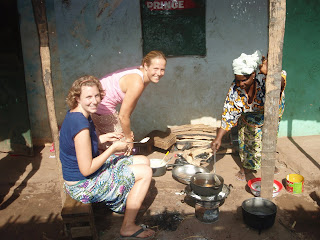 l panketos. And not only did we want to sell our panketos there, but we cooked them at the car park too. It was a fun social experiment to see the reaction from people when we told them we wanted to cook panketos and sell them. We made panketos filled with chocolate and peanut butter, panketos filled with banana, and panketos with an orange glaze. The entire experience was pretty hillarious. When the women walked by trying to sell us their panketos, we would try to sell them ours. Many people bought our panketos just out of curiosity of what these crazy white people were doing cooking and selling food in the dusty, crowded basse car park. But most people really liked them. They were especially confused though about having to make a choice between three different types. "What do you mean which one? I just want one panketo" While the experience was really just for fun, we are hoping that it might have inspired at least one person to get creative when it comes to selling their products.
 l panketos. And not only did we want to sell our panketos there, but we cooked them at the car park too. It was a fun social experiment to see the reaction from people when we told them we wanted to cook panketos and sell them. We made panketos filled with chocolate and peanut butter, panketos filled with banana, and panketos with an orange glaze. The entire experience was pretty hillarious. When the women walked by trying to sell us their panketos, we would try to sell them ours. Many people bought our panketos just out of curiosity of what these crazy white people were doing cooking and selling food in the dusty, crowded basse car park. But most people really liked them. They were especially confused though about having to make a choice between three different types. "What do you mean which one? I just want one panketo" While the experience was really just for fun, we are hoping that it might have inspired at least one person to get creative when it comes to selling their products.
James Njie turns one years old.
Little James turned one years old in February so I threw him a small birthday party, complete with noise makers and balloons. I made him a birthday hat that said "Hitande 1" (Hitande is "year" in Pulaar). He really didn't like wearing the hat though, so it ended up being passed between the other children. Liza and Ian both came up for the big event. We cooked black-bean chilli for my family and made a birthday cake in my sol ar oven.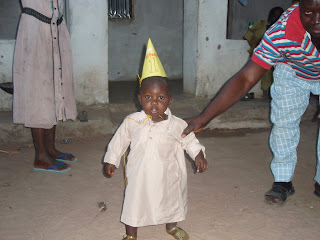
 ar oven.
Thursday, December 4, 2008
Mom and Dad in Africa
Well, my parents finally made it to The Gambia... they left yesterday. I was sad to see them go, but we had a great time while they were here.
We spent the first week traveling upcountry to see some local tourist sights and visit my village. It was a very busy but fun week. We joined a tour, which traveled partially by land and partially by boat. I especially enjoyed the boating parts of our trip. I've traveled the length of this country more times than I can count now, but always by public transport on poor roads. For a country that pretty much consists of a river and the narrow strip of land that surrounds the river, it's not often that I get to travel on the river... so it was definitely a treat. And on top of that, we really traveled in style on our boat trips. We were served coffee and tea, cold beverages, and lunch. We even drank bottled wine (not wine in a box) out of real wine glasses! The other members of our tour were mostly bird enthusiasts from the UK. On our series of boat trips throughout the week and saw not only birds, but chimpanzees, hippos, dolphins, monkeys, and baboons. It was a nice reminder that I do live in Africa, after all. Usually, the only animals I see are goats, sheep chickens, and cows.
For one day of our trip, we made it to Fat oto, where my American family was finally able to meet my Gambian family... and my father, James, was able to meet his tokara (name-sake), James. They also ate some good Gambian food and were able to visit my school and meet some of the teachers I work with. One of the highlights of my trip was that my mother stayed in Fatoto with me overnight. It was a short visit, but at least we had time to walk around my village, meet some
lunch in my hut
of my students, and spend some time visiting with my family. She was subjected to Pulaar lessons from my brother, Samba. She took bucket baths and used the pit latrine like a pro. She even traveled back to Basse with me in an overcrowded Gile Gile. She did great.
My Gambian family was thrilled to have my parents there. It meant as much to them as it meant to me.

James with James
Other hightlights of the upcountry trip: We spent one whole day in Basse, seeing the sights and hanging out with my Basse family and friends, mom and dad had the experience of having to help push-start one of the vans we were traveling in (a true Gambian experience), I finally got to see dad sleep in a tent, and mom and I took jimbeh (drumming) lessons, followed by African dancing.
After our week upcountry, we spent one week at the beach. We took a few "excursions" for shopping and sight-seeing, but mostly just spent time relaxing and eating good food. I know my parents were relieved to be sleeping in airconditioned rooms with constant electricity after some their upcountry accomodations. And now that I've had a week to relax, it's time to head back upcountry and back to work!
We spent the first week traveling upcountry to see some local tourist sights and visit my village. It was a very busy but fun week. We joined a tour,
 which traveled partially by land and partially by boat. I especially enjoyed the boating parts of our trip. I've traveled the length of this country more times than I can count now, but always by public transport on poor roads. For a country that pretty much consists of a river and the narrow strip of land that surrounds the river, it's not often that I get to travel on the river... so it was definitely a treat. And on top of that, we really traveled in style on our boat trips. We were served coffee and tea, cold beverages, and lunch. We even drank bottled wine (not wine in a box) out of real wine glasses! The other members of our tour were mostly bird enthusiasts from the UK. On our series of boat trips throughout the week and saw not only birds, but chimpanzees, hippos, dolphins, monkeys, and baboons. It was a nice reminder that I do live in Africa, after all. Usually, the only animals I see are goats, sheep chickens, and cows.
For one day of our trip, we made it to Fat
 oto, where my American family was finally able to meet my Gambian family... and my father, James, was able to meet his tokara (name-sake), James. They also ate some good Gambian food and were able to visit my school and meet some of the teachers I work with. One of the highlights of my trip was that my mother stayed in Fatoto with me overnight. It was a short visit, but at least we had time to walk around my village, meet some
lunch in my hut
of my students, and spend some time visiting with my family. She was subjected to Pulaar lessons from my brother, Samba. She took bucket baths and used the pit latrine like a pro. She even traveled back to Basse with me in an overcrowded Gile Gile. She did great.
My Gambian family was thrilled to have my parents there. It meant as much to them as it meant to me.

James with James
Other hightlights of the upcountry trip: We spent one whole day in Basse, seeing the sights and hanging out with my Basse family and friends, mom and dad had the experience of having to help push-start one of the vans we were traveling in (a true Gambian experience), I finally got to see dad sleep in a tent, and mom and I took jimbeh (drumming) lessons, followed by African dancing.
After our week upcountry, we spent one week at the beach. We took a few "excursions" for shopping and sight-seeing, but mostly just spent time relaxing and eating good food. I know my parents were relieved to be sleeping in airconditioned rooms with constant electricity after some their upcountry accomodations. And now that I've had a week to relax, it's time to head back upcountry and back to work!
Thursday, November 20, 2008
Adventures in West Africa
In October, Josiah and I traveled through Senegal, Mali, and Guinea. It was a great trip, overall, but not everythin g went as smoothly as planned. There were more than a handful of situations which tested our patience and tempers. Luckily, we turned out to be good travel partners. When we found ourselves extremely bored or anxious about something, Josiah kept us laughing with his unending reserve of poor jokes, random theoretical questions, or funny stories. Josiah combated the boring and tedious with witty and funny stuff. I kept us occupied with discussions of life, love, and spirituality. Between the two of us, we were able to stay sane through our more trying moments. We also found amusement in keeping a tally of various aspects of our trip. Here are some of the numbers from our tally. (keep in mind, this was over a period of only 11 days).
Number of different currencies we used: 4
Number of international borders crossed: 5
Number of attempted bribes: 3
Number of encounters with aggressive officers carrying guns: 3
Number of times Kristy had to prevent Josiah from getting arrested: 3
Number of different types of public transport vehicles taken: 7
Number of hours spent waiting for transport: 57
Number of hours spent actually traveling: 78
Total number of travel hours: 135
Number of times we had to say “I don’t speak French. A nani Pulaar?” (“Do you speak Pulaar?”):
 g went as smoothly as planned. There were more than a handful of situations which tested our patience and tempers. Luckily, we turned out to be good travel partners. When we found ourselves extremely bored or anxious about something, Josiah kept us laughing with his unending reserve of poor jokes, random theoretical questions, or funny stories. Josiah combated the boring and tedious with witty and funny stuff. I kept us occupied with discussions of life, love, and spirituality. Between the two of us, we were able to stay sane through our more trying moments. We also found amusement in keeping a tally of various aspects of our trip. Here are some of the numbers from our tally. (keep in mind, this was over a period of only 11 days).
Number of different currencies we used: 4
Number of international borders crossed: 5
Number of attempted bribes: 3
Number of encounters with aggressive officers carrying guns: 3
Number of times Kristy had to prevent Josiah from getting arrested: 3
Number of different types of public transport vehicles taken: 7
Number of hours spent waiting for transport: 57
Number of hours spent actually traveling: 78
Total number of travel hours: 135
Number of times we had to say “I don’t speak French. A nani Pulaar?” (“Do you speak Pulaar?”):
approximately 20 times a day
Number of cups of coffee consumed (each): 28
Number of times we ate meals consisting of a combination of beef and egg: at least once a day
Number of cans of tuna we hauled along on the trip and consumed: 20
Number of salads consumed: 1 (each)
Number of times we were called “toubab”: 10 times, and all within the final 8 hours of the trip
Number of kilometers hiked through the beautiful forests of Guinea: 24
Number of open soars on Kristy’s feet after the 18km hike: 10
Number of stressful situations that occurred in Guinea (excluding travel situations): 0
Josiah and I think these numbers speak for themselves, but for those who would like a little further explanation, here is the story our adventure…
The logical place to begin a trip east from The Gambia is from the bustling “city” of Basse, which has a large car garage with vehicles traveling to all major towns in Senegal and surrounding countries on most days of the week. The logical choice, however, was not the way we decided to go. If you look on a map, my village- Fatoto- is far closer to Tamaba Kounda (the first major town we would be traveling through) than Basse. Leaving from Basse would have meant traveling west from Fatoto to Basse, then back east again to Tamba. Besides, Josiah wanted to come visit my village for a few days before the trip. So we decided to take a “short cut” to Tamba from Fatoto.
The only problem with leaving from Fatoto was figuring out how we would get to Senegal. I am less than 15km from the eastern border of The Gambia and Senegal, but transport East from Fatoto is practically non-existent. My brother, Samba, told me about these tractors, which pick up bags of sugar in the Fatoto market and transport them to the border town, Picadus, in Senegal (sugar in Senegal is much more expensive than in The Gambia so they smuggle it across the border, then sell it for a profit). Samba assured me that the sugar tractors ran every day. So that was our plan… to hitch a ride on a sugar tractor to the border, and catch public transport from there. (I have to throw in a cheesy pun here. When I told my site-mate, Ian, about our plans to ride with the sugar tractor, he said “That should be a sweet ride!” ha ha.)
Due to the fact that we live in Africa, and should never have counted on something which happens consistently every day to happen on the day we want it to… we discovered the day before we were planning to depart for our trip that there was a good chance that no sugar tractor would be leaving the next day. They had hauled too many bags the day before, and probably wouldn’t have a full load to haul the following day. So we had to devise another form of transport. We considered walking it. But 13km with our large packs seemed a little ambitious. I spoke with one of my friends, Cherno, about hiring his donkey cart to give us a ride. He said he would be happy to let us use the donkey cart, but his donkey was pregnant, and could not make the journey. So then we asked a second man, Omar, if we could hire his donkey to use with Cherno’s cart. He agreed, so now we began negotiating the price. Negotiating and bargaining are the way things work here, but it can get tricky – especially when you have to negotiate with 2 people for the same service. After about an hour of negotiations, we came to an agreement and paid our money. They told us to come at 6:30 in the morning and we would leave.
The next morning, the donkey cart was only an hour late (not a bad wait for transport in Africa). Our “chauffeurs” were the two adolescent sons of Omar, the owner of the donkey. The road was very bad. In fact, it’s difficult to even call it a road in some places. Needless to say, it was a bumpy ride, and I felt lucky that I only fell off of the cart once. When we weren’t holding on for dear life, we were enjoying the scenery. We passed through villages and areas of The Gambia that most people never see. We felt the donkey cart ride was an appropriate way to begin our trip (thus began the tally of number of different types of public transport vehicles we used).
From Picadus, we caught a ride with a Gile Gile going to Tamba. Here, we were excited to find a restaurant that served hamburgers (hamburgers are a delicacy for us). The waitress asked if we wanted hamburgers or a king burgers. We had to laugh. The answer was obvious. “Bring us King Burgers, of course.” A king burger is a hamburger served French-style: two hamburger patties with a fried egg on top. Senegal is one of the many West African countries previously colonized by the French. Therefore, the main language spoken in Senegal is French, the currency is the CFA (Central African Franc), and much of the culture (including the food) has a French influence as well. Hence, the King Burger. We were so impressed by our King Burgers in Tamba, and we knew that all of the countries we would be traveling through are French-speaking countries, so we decided to make it a goal to eat as many king burgers as possible on this trip. (Thus, the beginning of another tally: number of king burgers or other combinations of beef and egg eaten on the trip). Obviously, nutrition was not a huge priority for us. This was our vacation. Bring on the king burgers.
After gorging ourselves on King Burgers, we found a bar that was playing the big football game between The Gambia and Senegal. (Just a side note here- by “football,” I’m talking about the game that everyone in the world besides Americans call football… not the US version of football, which involves very little contact between the foot and the ball). This was an important game for both Gambians and Senegalese, since they have traditionally been huge rivals. We sat in the very back and quietly rooted for The Gambia. Luckily, we left before the end of the game, which ended in a tie score between the two countries, knocking Senegal out of the play-offs and causing riots throughout the country.
The next day, we left Tamba, headed to the town of Kadira, which lies on the border between Senegal and Mali, and boarded a large bus for Bamako (the capital of Mali). At the border, we encountered our first aggressive officer with a gun (the first of yet another tally). He was the immigration officer. It seems that the basic role of an immigration officer is to collect all the passports and ID cards of the passengers in a vehicle and inspect them for authenticity and/or the presence of visas, if required. By holding on to everyone’s ID cards, they are able to collect bribes by demanding money in exchange for the return of your passport or ID card. And this guy was determined to get paid. He denied being able to speak any language besides French, which forced us to solicit help from one of the few English-speaking passengers on our bus. He was a nice man who was unfortunate enough to help us by translating for this belligerent officer. What caused the trouble was that we did not have visas for Mali, but this was not our fault. The Malian embassy in The Gambia does not issue visas, and told us that we would be able to buy them at the border. The officer told us our visas would cost 15,000 CFA (about $33) a piece, and we would also have to pay an additional 33,000 CFA each as a “penalty.” After many words were passed through our poor translator, the officer was getting very angry and shouting at all three of us in French. Josiah was loosing his composure, and I was forced to take over negotiations. Eventually, I decided to call the Peace Corps Safety and Security officer in Mali, but when I pulled out the phone to make the call, the officer angrily conceded to giving us our visas for 15,000 CFA a piece and dismissed the “penalty”. Unfortunately, when he realized he would not be able to get his bribe from us, he held the ID card of our “translator,” requiring him to pay 5,000 CFA before getting it back. Upon returning to the bus, we refunded the man’s money. We felt terrible that he was forced to pay simply for helping us.
Due to our delay at the border and several other long stops along the way, we didn’t arrive in Bamako until 3:30 in the morning. After a few hours of sleep, we found our way to the Peace Corps office in Bamako. This was on a Monday morning. One of the things we needed to do in Mali was fill out our ballots for the American elections. The reason why we needed to do this in Mali was because Peace Corps The Gambia had decided that the way they would get all Gambian PCV’s to vote was by sending ballots on October mail-run. They sent a message at the end of September to all PCV’s, stating that we should be at our sites when mail-run arrived so that we could receive the write-in ballots and vote. Mail-run would bring all the ballots back to the capitol, and they would mail them all out together. Unfortunately, Josiah and I would both be traveling when mail run came to our sites in October. I completed and mailed the paperwork for my absentee ballot in April, but had not received it yet. Before the trip, I called the office, searching for any alternative we may have to still be able to vote in the elections. Our office called ahead to the Malian office, and found out that we could vote through them, and they would mail the ballots for us… so that’s what we decided to do.
Unfortunately, we arrived at the office on Columbus Day… Not a holiday celebrated in Africa unless you work for an American institution like the Peace Corps. So the office was closed. We would have to vote on Tuesday. I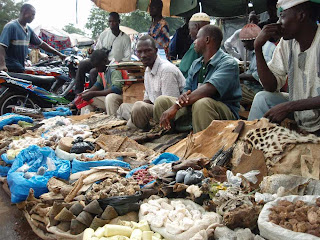 n the meantime, we found a room with the Catholic Mission in Bamako and set out to explore the city. Bamako is huge, busy, and crowded. The streets are packed with traffic and road-side vendors. There was much to do and see. We walked through the immense market, including the “fetish,” or witchcraft market, which consisted of vendors selling all sorts of creepy items: animal heads and bones, a variety of herbs, plants, animal skins, and much more. The street food in Bamako is delicious. I found fried dough patties filled with ground beef and boiled eggs, which I nicknamed “fried king burgers.”
Number of cups of coffee consumed (each): 28
Number of times we ate meals consisting of a combination of beef and egg: at least once a day
Number of cans of tuna we hauled along on the trip and consumed: 20
Number of salads consumed: 1 (each)
Number of times we were called “toubab”: 10 times, and all within the final 8 hours of the trip
Number of kilometers hiked through the beautiful forests of Guinea: 24
Number of open soars on Kristy’s feet after the 18km hike: 10
Number of stressful situations that occurred in Guinea (excluding travel situations): 0
Josiah and I think these numbers speak for themselves, but for those who would like a little further explanation, here is the story our adventure…
The logical place to begin a trip east from The Gambia is from the bustling “city” of Basse, which has a large car garage with vehicles traveling to all major towns in Senegal and surrounding countries on most days of the week. The logical choice, however, was not the way we decided to go. If you look on a map, my village- Fatoto- is far closer to Tamaba Kounda (the first major town we would be traveling through) than Basse. Leaving from Basse would have meant traveling west from Fatoto to Basse, then back east again to Tamba. Besides, Josiah wanted to come visit my village for a few days before the trip. So we decided to take a “short cut” to Tamba from Fatoto.
The only problem with leaving from Fatoto was figuring out how we would get to Senegal. I am less than 15km from the eastern border of The Gambia and Senegal, but transport East from Fatoto is practically non-existent. My brother, Samba, told me about these tractors, which pick up bags of sugar in the Fatoto market and transport them to the border town, Picadus, in Senegal (sugar in Senegal is much more expensive than in The Gambia so they smuggle it across the border, then sell it for a profit). Samba assured me that the sugar tractors ran every day. So that was our plan… to hitch a ride on a sugar tractor to the border, and catch public transport from there. (I have to throw in a cheesy pun here. When I told my site-mate, Ian, about our plans to ride with the sugar tractor, he said “That should be a sweet ride!” ha ha.)
Due to the fact that we live in Africa, and should never have counted on something which happens consistently every day to happen on the day we want it to… we discovered the day before we were planning to depart for our trip that there was a good chance that no sugar tractor would be leaving the next day. They had hauled too many bags the day before, and probably wouldn’t have a full load to haul the following day. So we had to devise another form of transport. We considered walking it. But 13km with our large packs seemed a little ambitious. I spoke with one of my friends, Cherno, about hiring his donkey cart to give us a ride. He said he would be happy to let us use the donkey cart, but his donkey was pregnant, and could not make the journey. So then we asked a second man, Omar, if we could hire his donkey to use with Cherno’s cart. He agreed, so now we began negotiating the price. Negotiating and bargaining are the way things work here, but it can get tricky – especially when you have to negotiate with 2 people for the same service. After about an hour of negotiations, we came to an agreement and paid our money. They told us to come at 6:30 in the morning and we would leave.
The next morning, the donkey cart was only an hour late (not a bad wait for transport in Africa). Our “chauffeurs” were the two adolescent sons of Omar, the owner of the donkey. The road was very bad. In fact, it’s difficult to even call it a road in some places. Needless to say, it was a bumpy ride, and I felt lucky that I only fell off of the cart once. When we weren’t holding on for dear life, we were enjoying the scenery. We passed through villages and areas of The Gambia that most people never see. We felt the donkey cart ride was an appropriate way to begin our trip (thus began the tally of number of different types of public transport vehicles we used).
From Picadus, we caught a ride with a Gile Gile going to Tamba. Here, we were excited to find a restaurant that served hamburgers (hamburgers are a delicacy for us). The waitress asked if we wanted hamburgers or a king burgers. We had to laugh. The answer was obvious. “Bring us King Burgers, of course.” A king burger is a hamburger served French-style: two hamburger patties with a fried egg on top. Senegal is one of the many West African countries previously colonized by the French. Therefore, the main language spoken in Senegal is French, the currency is the CFA (Central African Franc), and much of the culture (including the food) has a French influence as well. Hence, the King Burger. We were so impressed by our King Burgers in Tamba, and we knew that all of the countries we would be traveling through are French-speaking countries, so we decided to make it a goal to eat as many king burgers as possible on this trip. (Thus, the beginning of another tally: number of king burgers or other combinations of beef and egg eaten on the trip). Obviously, nutrition was not a huge priority for us. This was our vacation. Bring on the king burgers.
After gorging ourselves on King Burgers, we found a bar that was playing the big football game between The Gambia and Senegal. (Just a side note here- by “football,” I’m talking about the game that everyone in the world besides Americans call football… not the US version of football, which involves very little contact between the foot and the ball). This was an important game for both Gambians and Senegalese, since they have traditionally been huge rivals. We sat in the very back and quietly rooted for The Gambia. Luckily, we left before the end of the game, which ended in a tie score between the two countries, knocking Senegal out of the play-offs and causing riots throughout the country.
The next day, we left Tamba, headed to the town of Kadira, which lies on the border between Senegal and Mali, and boarded a large bus for Bamako (the capital of Mali). At the border, we encountered our first aggressive officer with a gun (the first of yet another tally). He was the immigration officer. It seems that the basic role of an immigration officer is to collect all the passports and ID cards of the passengers in a vehicle and inspect them for authenticity and/or the presence of visas, if required. By holding on to everyone’s ID cards, they are able to collect bribes by demanding money in exchange for the return of your passport or ID card. And this guy was determined to get paid. He denied being able to speak any language besides French, which forced us to solicit help from one of the few English-speaking passengers on our bus. He was a nice man who was unfortunate enough to help us by translating for this belligerent officer. What caused the trouble was that we did not have visas for Mali, but this was not our fault. The Malian embassy in The Gambia does not issue visas, and told us that we would be able to buy them at the border. The officer told us our visas would cost 15,000 CFA (about $33) a piece, and we would also have to pay an additional 33,000 CFA each as a “penalty.” After many words were passed through our poor translator, the officer was getting very angry and shouting at all three of us in French. Josiah was loosing his composure, and I was forced to take over negotiations. Eventually, I decided to call the Peace Corps Safety and Security officer in Mali, but when I pulled out the phone to make the call, the officer angrily conceded to giving us our visas for 15,000 CFA a piece and dismissed the “penalty”. Unfortunately, when he realized he would not be able to get his bribe from us, he held the ID card of our “translator,” requiring him to pay 5,000 CFA before getting it back. Upon returning to the bus, we refunded the man’s money. We felt terrible that he was forced to pay simply for helping us.
Due to our delay at the border and several other long stops along the way, we didn’t arrive in Bamako until 3:30 in the morning. After a few hours of sleep, we found our way to the Peace Corps office in Bamako. This was on a Monday morning. One of the things we needed to do in Mali was fill out our ballots for the American elections. The reason why we needed to do this in Mali was because Peace Corps The Gambia had decided that the way they would get all Gambian PCV’s to vote was by sending ballots on October mail-run. They sent a message at the end of September to all PCV’s, stating that we should be at our sites when mail-run arrived so that we could receive the write-in ballots and vote. Mail-run would bring all the ballots back to the capitol, and they would mail them all out together. Unfortunately, Josiah and I would both be traveling when mail run came to our sites in October. I completed and mailed the paperwork for my absentee ballot in April, but had not received it yet. Before the trip, I called the office, searching for any alternative we may have to still be able to vote in the elections. Our office called ahead to the Malian office, and found out that we could vote through them, and they would mail the ballots for us… so that’s what we decided to do.
Unfortunately, we arrived at the office on Columbus Day… Not a holiday celebrated in Africa unless you work for an American institution like the Peace Corps. So the office was closed. We would have to vote on Tuesday. I
 n the meantime, we found a room with the Catholic Mission in Bamako and set out to explore the city. Bamako is huge, busy, and crowded. The streets are packed with traffic and road-side vendors. There was much to do and see. We walked through the immense market, including the “fetish,” or witchcraft market, which consisted of vendors selling all sorts of creepy items: animal heads and bones, a variety of herbs, plants, animal skins, and much more. The street food in Bamako is delicious. I found fried dough patties filled with ground beef and boiled eggs, which I nicknamed “fried king burgers.”
One of our favorite places in Bamako was a bar and restaurant called ‘the Apaloosa”. Picture this if you can: The owners are French, the cocktail waitresses are Ukrainian and Malian, and the wait staff are Malian. The owners have a strange affinity for the American West. The place was full of pictures of Native American Indian Chiefs and cowboy paraphernalia, as well as other American pop culture items. There was a large American flag with a picture of Jimi Hendrix printed over the stars. There were American license plates and bumper stickers. Josiah said the walls looked a lot like a TIG Fridays or Chilis. And the best part: the Malian waiters wore complete cowboy ensembles, including cowboy hats.
We enjoyed Bamako, but we struggled with language. The official language in Mali is French, but the dominant native language is Bombara, which is similar to the Gambian language, Mandinka. Both Josiah and I were taught Pulaar, the language of the Fula tribe. Fulas are all over West Africa, and we were lucky enough to find a few in Bamako, but not many. And although we’re both familiar with Mandinka, neither of us speak it well enough for it to help us understand or communicate with Bomaras. In addition, neither of us speak French.
One unfortunate incident occurred while in Bamako: while walking back to our room from the large market, I was taking pictures of the streets of Bamako with my brand new camera. There is so much to see on these streets. We passed a crowded alley full of people shopping and selling goods. I snapped a picture of the alley, which, unfortunately, was right next to a large bank. In front of the bank was a security officer (this is #2 on the aggressive officer with a gun tally)… The man shouted for us to come to him. Looking back on it now, I wish we had just kept walking, but instead, we obeyed and went to him. He was pointing at my camera and shouting at us in French. I may not be able to speak French, but I could understand that he was upset about the picture I had just taken. I was about to turn my camera on to show him that the picture I took was a picture of the market… not a picture of him. At this point, he and second officer both grabbed me by the arms as he tried to pry the camera out of my hands. I was holding onto it tightly. At some point in the chaos, I heard Josiah’s voice in my ear: “Kristy, let go of the camera.” I let go, and the officer took the camera and put it in his pocket. I asked Josiah “Why did you tell me to let go? Now he’s going to keep my camera.” Josiah responded, “Well, you had two men with guns grab you violently and try to take your camera, but you refused to let go of it. I was worried about what they would do next.”
Josiah went to find a phone to call the Peace Corps office while I stayed with the officer, trying my best to communicate with him. After much pleading, we finally went inside the bank to talk to the bank manager, who also could not speak English. Eventually, I did get my camera back, but it was a grueling process. And being a Peace Corps Volunteer is what probably saved the day. In Africa, white skin is a symbol of wealth. Almost everyone believes that being white means being rich. It helps that I can speak one African language and that I have a better-than-average understanding of West African culture. However, I am still white, which makes me a red flag for greedy people looking for money. As often as I’ve found myself trying to reason with people who tell me I am rich, I also can’t help but understand why they believe this. By American standards, I am nothing close to rich ( I live off a few dollars a day), but in comparison to most people here, I am still rich. The camera I was using was a gift from my family. It was probably worth a half a year’s salary to that man. It didn’t justify his aggressive actions, but his ignorance is based on truth.
We enjoyed Bamako, but we struggled with language. The official language in Mali is French, but the dominant native language is Bombara, which is similar to the Gambian language, Mandinka. Both Josiah and I were taught Pulaar, the language of the Fula tribe. Fulas are all over West Africa, and we were lucky enough to find a few in Bamako, but not many. And although we’re both familiar with Mandinka, neither of us speak it well enough for it to help us understand or communicate with Bomaras. In addition, neither of us speak French.
One unfortunate incident occurred while in Bamako: while walking back to our room from the large market, I was taking pictures of the streets of Bamako with my brand new camera. There is so much to see on these streets. We passed a crowded alley full of people shopping and selling goods. I snapped a picture of the alley, which, unfortunately, was right next to a large bank. In front of the bank was a security officer (this is #2 on the aggressive officer with a gun tally)… The man shouted for us to come to him. Looking back on it now, I wish we had just kept walking, but instead, we obeyed and went to him. He was pointing at my camera and shouting at us in French. I may not be able to speak French, but I could understand that he was upset about the picture I had just taken. I was about to turn my camera on to show him that the picture I took was a picture of the market… not a picture of him. At this point, he and second officer both grabbed me by the arms as he tried to pry the camera out of my hands. I was holding onto it tightly. At some point in the chaos, I heard Josiah’s voice in my ear: “Kristy, let go of the camera.” I let go, and the officer took the camera and put it in his pocket. I asked Josiah “Why did you tell me to let go? Now he’s going to keep my camera.” Josiah responded, “Well, you had two men with guns grab you violently and try to take your camera, but you refused to let go of it. I was worried about what they would do next.”
Josiah went to find a phone to call the Peace Corps office while I stayed with the officer, trying my best to communicate with him. After much pleading, we finally went inside the bank to talk to the bank manager, who also could not speak English. Eventually, I did get my camera back, but it was a grueling process. And being a Peace Corps Volunteer is what probably saved the day. In Africa, white skin is a symbol of wealth. Almost everyone believes that being white means being rich. It helps that I can speak one African language and that I have a better-than-average understanding of West African culture. However, I am still white, which makes me a red flag for greedy people looking for money. As often as I’ve found myself trying to reason with people who tell me I am rich, I also can’t help but understand why they believe this. By American standards, I am nothing close to rich ( I live off a few dollars a day), but in comparison to most people here, I am still rich. The camera I was using was a gift from my family. It was probably worth a half a year’s salary to that man. It didn’t justify his aggressive actions, but his ignorance is based on truth.
After this encounter, we decided to cut our trip to Mali short by a day or two. I was ready to head to Guinea, where Fula is a common language, and we would be hiking through forests in the mountains. We arrived at the garase (place for taking public transport) in Bamako at nine in the morning on a Thursday. The way transport works in many places is like this: you join a vehicle, pay for your ticket, then wait until all the seats are full. I've had to wait hours in The Gambia before for one vehicle to fill before we can leave. That's why, in The Gambia, I often travel in a vehicle called a "set-plas," which is a french word borrowed from the Senegalese, meaning "seven seats." These are what we would call a station wagon in the states. In a set-plas, one person sits in the passenger seat next to the driver, three in the middle, and three in the back. These vehicles are more expensive than the common Gile Gile, but they fill faster and make fewer stops, making them ideal for traveling longer distances. In The Gambia and Senegal, drivers are penalized if it is discovered that they have more than seven people in one of these vehicles. Hence, the "set-plas" part of it.
In Guinea, however, the roads are too poor for larger vehicles like Gile Gile's and Busses. So the "set-plas" is the primary means of transport. But they have no regulations for how many people can be seated inside of one. So Guinean drivers typically squeeze about 9 inside: 2 in the front seat, 4 in the middle, and 3 in the back. Then they allow other passengers to ride on top of the vehicle. So it was one of these vechicles that we were taking to Guinea. Josiah and I were numbers 4 and 5. We still had 4 passengers left before we could leave. So we waited, and we waited, and we waited. It's amazing how time seems to have a different quality to it when you are just waiting around. I made friends with a nice Fula lady who was selling food in the garase. I sat with her all day long and watched her fry up pieces of plantains, sweet potatoes and potatoes. Josiah wandered most of the day. Sometimes he would sit in the car. Sometimes he would join me and my new friend, Fatoumata. Sometimes he just wandered around. He became particularly attached to the senile old lady in our vehicle that we nicknamed "crazy," after we found her talking to her reflection in the car window. Josiah and Crazy would sit in the car together and share food... she would pass him peices of oranges, and he would bring her some of the fried plantains that Fatoumata had cooked. After waiting for 10 hours (at this point, it's dark outside), the driver told us we would have to come back in the morning. We found a hotel room, slept a few hours, and returned early the next morning.
Our car finally left at 8:30... we were excited to be moving on. At the border of Mali and Guinea, we encountered our third agressive officer with a gun. Actually, he was quite calm compared to our first two, but was still requiring us to give him a bribe. I called the Peace Corps Saftey and Security Officer in Guinea, and handed the phone over to the immigration officer... Yet another incident where it was good to be a Peace Corps Volunteer.
After traveling for 21 hours, we arrived in the town of Pita, where we stayed for one day and one night. Josiah slept for most of the day, while I walked around town and into the market. Pita is a large town surrounded by mountains and rivers. The weather was cool and sunny. The people were almost all Fulas... so I could actually talk to them. The food was delicious, and cheep. I ate a lot of local fruit. Oranges, guavas and a strange-looking fruit the locals called sop-sop.
The next day, w e took transport to the small village of Douke, where a man name Hassan Bah (a Fula), runs a sort of eco-lodge experience. "Eco" in the sense that you live in a hut, use a guest house, and bathe outside (This is really no different from how I live in village regularly, so it was kind of like being "home"). Then, either Hassan or his brother Abdoulie, take the guests on hiking tours through the forests to see amazing rock formations, cliffs, valleys, and waterfalls. They also provide all of your meals. We only stayed for 2 days, but I wish we could have stayed longer. The scenery was amazing. The weather was beautiful. It was exactly what I needed after our hectic travels through Mali.
 e took transport to the small village of Douke, where a man name Hassan Bah (a Fula), runs a sort of eco-lodge experience. "Eco" in the sense that you live in a hut, use a guest house, and bathe outside (This is really no different from how I live in village regularly, so it was kind of like being "home"). Then, either Hassan or his brother Abdoulie, take the guests on hiking tours through the forests to see amazing rock formations, cliffs, valleys, and waterfalls. They also provide all of your meals. We only stayed for 2 days, but I wish we could have stayed longer. The scenery was amazing. The weather was beautiful. It was exactly what I needed after our hectic travels through Mali.
We went on a nice, easy hike our first day there. On the second day, Abdoulie took us for a strenuous 18km hike that they have named "Chutes and Ladders." The first 10 -12 km of the hike is all down-hill through high grasses, rocky paths and overgrown trails. It was beautiful, but I couldn't help thinking "We're still going down. We'll have to begin going up at some point." We stopped for lunch by a waterfall before beginning our upward journey, and it's a good thing we did, because we really needed all the energy we could find. This was the part that earned the hike the title of "Chutes and Ladders." We were essentially climbing up a steep canyon wall. In some places, we used a steep and rocky path, but in other places, we had to climb ladders. The ladders are locally constructed from thick tree branches and peices of bark. They were very sturdy, but slippery in places. In some instances, the ladders were positioned right next to waterfalls, which provided a steady mist of water, making the wood slippery. I lost count of the number of ladders we climbed... perhaps 20? And the "trails" we used in between the ladders were just as challenging (continuously steep and slippery in places). I'm thankful that I managed to keep
 my balance. Josiah called the trail the "stair master." It never really flattened out until we were finished with our hike. We just climbed straight up for 8 km. I was wearing my new Chaoco hiking sandals, which still need some more "breaking-in." By the end of the hike, I counted 10 open cuts and blisters on my feet. As exhausted and soar as we were after finishing the hike, it was by far my favorite part of our trip. And here's an amazing fact: that path we hiked on is a main route for locals traveling between the villages on top of the canyon and in the valley below. The women climb those slippery ladders in flip-flops and with loads on their heads!
 hike our first day there. On the second day, Abdoulie took us for a strenuous 18km hike that they have named "Chutes and Ladders." The first 10 -12 km of the hike is all down-hill through high grasses, rocky paths and overgrown trails. It was beautiful, but I couldn't help thinking "We're still going down. We'll have to begin going up at some point." We stopped for lunch by a waterfall before beginning our upward journey, and it's a good thing we did, because we really needed all the energy we could find. This was the part that earned the hike the title of "Chutes and Ladders." We were essentially climbing up a steep canyon wall. In some places, we used a steep and rocky path, but in other places, we had to climb ladders. The ladders are locally constructed from thick tree branches and peices of bark. They were very sturdy, but slippery in places. In some instances, the ladders were positioned right next to waterfalls, which provided a steady mist of water, making the wood slippery. I lost count of the number of ladders we climbed... perhaps 20? And the "trails" we used in between the ladders were just as challenging (continuously steep and slippery in places). I'm thankful that I managed to keep
 my balance. Josiah called the trail the "stair master." It never really flattened out until we were finished with our hike. We just climbed straight up for 8 km. I was wearing my new Chaoco hiking sandals, which still need some more "breaking-in." By the end of the hike, I counted 10 open cuts and blisters on my feet. As exhausted and soar as we were after finishing the hike, it was by far my favorite part of our trip. And here's an amazing fact: that path we hiked on is a main route for locals traveling between the villages on top of the canyon and in the valley below. The women climb those slippery ladders in flip-flops and with loads on their heads!
After 2 days in Douke, we said farewell to Hassan and his family and headed to Labe, a crowded town with a busy market place. We walked around the town, bought some fruit from the market, ate some good food (including more king burgers), drank coffee and good beer, and found a cheep but clean place to stay the night. The next day, we decided to begin our journey back to The Gambia. This time, we headed to the car park fully prepared to wait a while, even stay an extra night if we needed to. After waiting for 11 hours, we were told there would be no cars leaving directly for Basse (possibly for several days), so we joined a vehicle going to Senegal. Once again, it was 10 people crammed into a station wagon. They told us we would have to share the front passenger seat. Thus began the most physically uncomfortable, sleep-deprived, 21 hour journey of my life. Looking back on the experience now, we have had a few good laughs, but at the time, it was pretty miserable. When we were finally dropped off in Senegal, we were thankful to get out of the car and stretch our cramped muscles. We waited a few more hours for yet another ride to Velengara, Senegal. This should have been a quick trip- about an hour- but our gile gile ran out of gas, so everyone in the vehicle had to get out and wait for a few more hours while the drivers went to find gas. Finally they returned, added a little bit of gasoline, push-started the vehicle, and eventually dropped us off in Velingara. At this point, we are less than 15 km from the border of The Gambia and Senegal, and less than 25 km from Basse. In Velingara, we had to deal with yet another money scam, which almost required another phone call to Peace Corps. Fortunately, we settled it ourselves before it got too far. After waiting for yet another vehicle to fill, we finally piled into a "bush-taxi," which started after several pushes around the car park and spouted out a bunch of toxic fumes. At this point, the sun had set, and the road to Basse was terrible and full of huge mud puddles. We spent more time pushing the vehicle when it would get stuck or stall than we did actually inside of the vehicle. At one point, I realized I was standing knee deep in a large mud puddle and had lost my flip-flop somewhere... And we still had to go through customs and immigration for The Gambia.
About 37 hours after beginning our journey from Labe, we finally arrived in Basse, covered in mud, and absolutely exhausted. Traveling in West Africa is a truly unique experience. I'm happy that I did it, but as they like to say here... "It's not easy!"
So that's the whole trip, in perhaps more detail than it needed to be. We ended up coming back a few days earlier than planned, so we spent one whole day sleeping, and two more days just relaxing in Basse before heading back to our sites. It was quite an adventure!
Thursday, September 11, 2008
Today is September 11th. The new group swears-in as Peace Corps Vounteers tomorrow. They are very excited and quite ready to finish with training and get on with the rest of their service here. And I agree... it's been a busy 10 weeks. Since they arrived here on July 3rd, my life has been a blur of traveling between Fatoto and various training sessions. But my brief visits to Fatoto this summer were calm and relaxing. It rained there every day in August, which kept the temperatures down and made it possible for me to spend time lying in bed, listening to the rain patter on my family's corrogate roof and reading books. I've always enjoyed rainy days, but after the 3 months of living through temperatures in the 110's and 120's, I have a whole new aprreciation for rain, or even just clouds. The country has undergone it's rainy season transformation. Areas that were sandy, brown, and barren are all lush and green now. The roads, which are difficult enough to travel in the dry season are just patches of mud, with scattered lakes and numerous potholes. Every available patch of land has been sowed with seeds of millet, rice, and corn. Most of these plants are already taller than I am.
When it was not raining, I was outside in my garden, weeding and composting and sowing new seeds. Those who sent me seeds from the states will be happy to hear that I've managed to get some of them to grow, including zucinni, cucumber, cilantro, basil, sunflowers, and watermellon. In addition, I have three garden beds full of tomato plants, one bed of bell pepper plants, and a few sickly-looking cabage plants. Nothing has fruited yet, but some of my plants have begun to flower. I also intercropped squash, pumpkin, and watermellon in my family's cous fields, which have also begun to grow nicely. I've discovered a new passion for gardening that I never knew I had before now. Sometimes I wonder what my Peace Corps experience would be like if I could just plant seeds and work in gardens all day. I hope that I'll have the time keep up with it once school starts.
I will be heading back to Fatoto on Sunday. School was supposed to open this week, but in typical Gambian fashion, few teachers, headmasters, or students actually show up for the first week of school... so I'm not actually missing anything. I'm excited and hesitant to get back into the classroom. I am working on a few projects that I'd like to implement in my school and my community this year. If I manage to do it all, it will be a busy year, once again. In addition, I'm planning on taking a few weeks off of school next month and actually getting out of The Gambia. Josiah and I have decided to do a little bit of traveling. Originally, we planned on traveling to Sierra Leone, but after researching the costs of that trip, we've decided to do a slightly different trip. The visa itself for Sierra Leonne is $100. There are less expensive countries to travel through, so we will be traveling through Senegal, Mali, and Guinea. I'm really looking forward to it. Now that I've traveled all of my little slice of West Africa, I'm ready to see some more!
When it was not raining, I was outside in my garden, weeding and composting and sowing new seeds. Those who sent me seeds from the states will be happy to hear that I've managed to get some of them to grow, including zucinni, cucumber, cilantro, basil, sunflowers, and watermellon. In addition, I have three garden beds full of tomato plants, one bed of bell pepper plants, and a few sickly-looking cabage plants. Nothing has fruited yet, but some of my plants have begun to flower. I also intercropped squash, pumpkin, and watermellon in my family's cous fields, which have also begun to grow nicely. I've discovered a new passion for gardening that I never knew I had before now. Sometimes I wonder what my Peace Corps experience would be like if I could just plant seeds and work in gardens all day. I hope that I'll have the time keep up with it once school starts.
I will be heading back to Fatoto on Sunday. School was supposed to open this week, but in typical Gambian fashion, few teachers, headmasters, or students actually show up for the first week of school... so I'm not actually missing anything. I'm excited and hesitant to get back into the classroom. I am working on a few projects that I'd like to implement in my school and my community this year. If I manage to do it all, it will be a busy year, once again. In addition, I'm planning on taking a few weeks off of school next month and actually getting out of The Gambia. Josiah and I have decided to do a little bit of traveling. Originally, we planned on traveling to Sierra Leone, but after researching the costs of that trip, we've decided to do a slightly different trip. The visa itself for Sierra Leonne is $100. There are less expensive countries to travel through, so we will be traveling through Senegal, Mali, and Guinea. I'm really looking forward to it. Now that I've traveled all of my little slice of West Africa, I'm ready to see some more!
Tuesday, July 15, 2008
Training
The past three weeks have seemed to pass by in a blur... After finishing the planning sessions for PST, I had two or three blessed days to relax. One of these days was my 3oth birthday (June 30th). Luckily, most of my closest PCV friends were able to share it with me. When they asked what I wanted to do, I told them I wanted an American cook-out. So we grilled burgers, ate potato salad and garden salad, listened to music and just relaxed. It was perfect. Then a few days later, the pace of my life picked-up again...
The new group of education trainees arrived on July 3rd. I spent one hectic week in Kombo with them, running from one session to the next, spending time with them between and after their training sessions, and trying to sqeeze in my own meetings and work on secondary projects on the side. I've enjoyed getting to know the trainees and being a part of the training process so far, despite the long hours. They are so full of energy and motivation. In some ways, it has re-charged me a little too. I'm excited for them and all of the things they hope to achieve! I've especially gotten to know the fou r trainees that are learning to speak Pulaar, which is the language I learned (am still learning, actually). On Thursday, the trainees left for their training villages, and I went went them. I spent 3 days in a village called Fula Kunda, which was only 4km from my old training village, Jiroff, so I was able to go back and visit my old family for a few hours. It was nice to be back in my old training village when I could actually have converstations with people! The rest of the time, I spent with the trainees. In the beginning, I helped them set up things like their water filters and bed-nets, but I basically just answered a lot of their questions and provided a little emotional support. They seem to be going through the usual things that happen on your first move to village. Stomach issue, language communication problems, getting used to eating the food, missing family and friends, etc. A few of them had leaky houses or insect issues. In the beginning, these things can be overwhelming, but I think they're doing great despite it all. After only two days, they already started working together in the garden. A nice thing for me was that the four of them gave me thank-you letters and a little gift bag filled with treats they brought from the states to say thanks!
 r trainees that are learning to speak Pulaar, which is the language I learned (am still learning, actually). On Thursday, the trainees left for their training villages, and I went went them. I spent 3 days in a village called Fula Kunda, which was only 4km from my old training village, Jiroff, so I was able to go back and visit my old family for a few hours. It was nice to be back in my old training village when I could actually have converstations with people! The rest of the time, I spent with the trainees. In the beginning, I helped them set up things like their water filters and bed-nets, but I basically just answered a lot of their questions and provided a little emotional support. They seem to be going through the usual things that happen on your first move to village. Stomach issue, language communication problems, getting used to eating the food, missing family and friends, etc. A few of them had leaky houses or insect issues. In the beginning, these things can be overwhelming, but I think they're doing great despite it all. After only two days, they already started working together in the garden. A nice thing for me was that the four of them gave me thank-you letters and a little gift bag filled with treats they brought from the states to say thanks!
Tomorrow, I will be traveling back upcountry. I have been gone for over three weeks now. I miss Fatoto and I miss my family. I'm looking forward to getting back. It will only be a short trip though, because I will be meeting the trainees in Tendaba in less than two weeks! This summer will involve a lot of traveling for me, but I'm looking foward to some of the work I'll be doing. I'm sure September will come again before I know it....
Monday, June 30, 2008
Fudon
 For special occasions, African women like to dye their hands and feet in different patterns, using a plant they call Fudon. My sister, Salimatou (who lives in Senegal but was visiting last month) did my feet and her own.
Scorpion
 With the rains come all sorts of small creatures that have been in hiding through the hot season, including scorpions. This little guy was found right behind my back yard, hiding under a brick. We also found two more in my compound recently and my friend, Alieu, got a nasty sting from one the other day.
Neem insect repellant
 One activity I did with my science club was making making insect repellant. Leaves from the Neem tree naturally repell insects, so we extracted the insect repellant from the leaves by boiling them in water and using the water to make the lotion. The students sold the insect repellant in the community to raise money for the science club.
Sunday, June 29, 2008
Challenges from the last few months
I have just finished one more “chapter” in my life here in Africa. School is finished for the school year, I have finally prepared my garden and planted some of my seeds (including some of the seeds that were mailed to me from the US… lets keep our fingers crossed that they will grow here!), and I have also been coping, internally, with some serious cultural issues that have effected me on a deep emotional level (more on this later, perhaps). Between my work, extra projects, my emotional journey, and the continuous heat since February, the past few months have gone by in a blur. On Monday, I traveled from Fatoto to the Kombos to begin my training and preparation for PST (Pre-Service-Training) of the new group, who will be arriving on Thursday. It was the first time I have made the entire trip in a day, by myself. The trip took about 10 hours (which is making pretty good time for travel conditions in The Gambia, despite the fact that it’s less than 500 km), and I spent a good deal of this day reflecting on the whirlwind of events that have consumed my life recently. Since arriving, I have been caught-up in a series of training sessions, meetings, and reconnecting with friends, so today is the first opportunity that I have had to sit down and write about some of these things.
So first, some school stories....
My last trip to Kombo at the end of April for IST (In-Service-Training) took me from my classes for about a week and half. So upon returning to Fatoto, I was scrambling to make up the classes that I missed. With the limited time I have to teach, it makes it difficult to make-up for lost days (And there’s no such thing as “substitute teachers” in The Gambia). Keep in mind that the Gambian curriculum is shaped by the syllabus for the WASSCE exam. For general science, this comprises about 40 pages of science objectives that each student is “required” to learn from grade 10 thru grade 12 in preparation for the final exam. There is no division of material for each level, and the scope of material is vast. Topics range from human body systems (the skeletal system, the digestive system, the respiratory system, etc.), to basic biology (cells, biological classification, nutrition, ecology), to more advanced biology (genetics, photosynthesis, cellular respiration), to all levels of chemistry (the periodic table, chemical reactions, acids and bases, biochemistry, even organic chemistry), to all levels of physics (Newton’s laws, forces, torque, levers, electromagnetic radiation, magnetism, circuits, and much more), to geology (soil and water sciences), even nuclear fission and biotechnology. Basically, all of the topics that most high school students in the united states cover in a four year time period, while attending each class approximately five hours a week… these are expected of Gambian students to learn in three years, while attending each class for approximately 2 hours a week. Since I had little information about what each grade level learned in the prior years (teacher turn-over is high and there are no previous records to refer back to), I ended up developing my own list of topics, based on the syllabus, for each of the three grade levels, that I hoped would expand on the few things I was sure they had covered in previous years, after looking at old notebooks that students allowed me to borrow.
The most difficult class for me to teach this year was my grade 11 class. For this class, I decided to focus on basic Chemistry and Physics, since it seemed that none of the students in prior years had seemed to cover any of these things, and after looking at some copies of old WASSCE exams, I realized that at least 2/3 of the questions related to these branches of science. So I’ve found myself trying to teach topics that I learned years ago myself, with limited laboratory resources, and a classroom of students who’s math skills are at least 5 levels below their grade level, and who have little to no experience in abstract thinking skills. Needless to say, this adventure was a continuous learning process for my students, as well as for myself. At one point, I realized that we needed to stop and just practice math. We spent about three weeks on basic mathematics skills that are absolutely necessary to understand and complete basic science problems. For example, adding and subtracting negative numbers (My students told me that -3 plus 2 is 5), or simply dividing numbers like 25 into 100. Once you add a second digit onto a number, they loose any interest in trying to multiply or divide with that number. Even if it’s just a zero. Most students can’t tell me that 60 divided by 30 is 2. And don’t get me started on decimal points. I hate giving them any problem that involves numbers with decimal points. A few of them have calculators, but most cannot afford them, so I try my best to keep the math as simple as I can, just to get the basic scientific ideas across to them. Some of my students have been working very hard. I spend a lot of time after-school or in my compound with students that come for extra help. And fortunately, these students are excelling. I am very proud of them. But without the extra help, it would have been hopeless. I have experimented with different group-activities that divide my 4 or 5 exceptional students up into separate groups to work on problems with their classmates. We’ve turned them into friendly competitions between “teams,” and this has been somewhat successful. I’ve found that when a peer is available to explain a difficult concept, it can be immensely helpful for the struggling students. This is why I’m working on developing a peer tutoring program at Fatoto SSS, which I hope to implement next year. I’m also toying with the idea of starting a “Math club,” but I have few ideas of what I could do with a club like that, since my background is not in Math. So if anyone has any suggestions, I would definitely welcome them.
While I’m still on the topic of school, I would like to describe what I privately call the "final exam fiasco". Because the school does not have computers, typewriters, copy machines, or even electricity, it is impossible to type and print exams or tests. When we give tests to the students, the questions are written on the blackboard, and the students copy them down on a piece of paper, then answer the questions. This limits the amount of questions you can give on a test, and increases the opportunities for cheating, which is very common here, since most students just memorize sections of their notes and write them as answers on tests, whether they understand the words they are memorizing or not. For final exams, however, each student is supposed to have their own test copy for each subject. In order to accomplish this, all of us teachers had to type our final exam questions back in April and mail them (when I say “mail”, I mean pass them to someone who is traveling that way) 450 km to Kombo, where the school hires someone to type and copy each of the exams… then sends them back up-country, hopefully in time for the final exams. We received our exams in time, but when we opened them, we found terrible mistakes made by the typist, and they copying job was absurd. You couldn’t read most of the questions on some of the exams, which meant that before the exam, the teacher had to read each of the questions out-loud for the students to fill-in the missing portions on their exams. The Math exams were the worst, with numbers super-imposed on other numbers, and tons of mistakes in the problems which would change the entire outcome of the students’ answers unless corrected. On top of it all, I had gone through the trouble to type my own copy of the grade 11 exam because I wanted to include diagrams that I could not expect the typist to reproduce. I had done this on my last trip to Kombo in April, then met with someone who passed my exams along to the typist/copier. However, instead of simply copying my exam, which was already typed nicely with no mistakes, they re-typed it, with many mistakes, and excluded the diagrams completely. Those were the copies sent. We discovered this on a Monday, and they would be taking the exams on the following Tuesday. The principal decided to bring the original copy with him to Basse the next day, where he was traveling for a meeting, and make copies at the REO (Regional Education Office) there. When he returned to school on Thursday, I asked him if he was able to get the copies made. He said the REO was too busy to do it on Wednesday, but they said they would copy it and try to send it with someone heading to Fatoto before Tuesday. I was traveling to Basse on Saturday and returning on Sunday, so I told him that if they could give the copies to my friend who works at the REO, I could pick them up from her (the REO is closed on week-ends). He said he would call them and tell them. Then Fatoto lost all cell-phone service from Wednesday evening until Friday afternoon. No one was able to make or receive calls, so we could not get through to Basse until the REO was already closed for the day, and the papers were locked inside of it. After several phone calls, we still could not reach someone to get the papers for us. I traveled to Basse on Saturday to buy some fencing material for my backyard (which has fallen down four times now). I tried several times that weekend to reach someone who could help, but it was useless. On Sunday, I got onto a gile gile going back to Fatoto, just hoping that we could work it out in the next day. My gile gile stopped to get gas before leaving Basse, and as we were sitting there waiting, a motorcycle pulled up beside the vehicle and the man on the bike said “Are you Maimuna? These are for you.” and handed me the test papers. It was like some strange scene in a movie. I’m still not sure how he knew where to find me, but I’m happy he did!
Now allow me to describe the testing situation. The school moved all of the students’ desks into the rooms that would be the designated exam-taking rooms. The 7th and 8th graders were put together in the large assembly hall, and the 10th and 11th graders were put together in the library. (the 9th and 12th graders already took their exams). In the library, the students were seated, 2 to a desk… one tenth grader and one 11th grader together. Because of all the corrections that needed to be made on the exam, the teachers had to spend a significant amount of time reading the questions out-loud (for the 10th grade science exam, I spent an hour on this). Since there were two different grades taking exams in the same room, the teachers had to take turns correcting the mistakes with the class, since they could not both talk at the same time. There was a flip-chart at the front of the room for us to write on, but only about half of students were close enough to read it, which is why we had to read the corrections out-loud. So we probably wasted a good hour or more before each exam just making sure the students made all of the necessary corrections. Then, since each teacher set different time-limits on their exams, and all exams had two parts (objective and theory), there were constant interruptions when one group finished and left while the other group was still working, or when one group began the next portion of the test and the teacher had to make more corrections. Then the students were trying to share things like calculators and pencils, which caused even more interruptions (Since materials are scare, students are accustomed to sharing in class, but they don’t understand why you cannot do this on a final exam). The whole process was disorganized and disruptive. And I’m not convinced all students were able to make all of their necessary corrections, so they probably answered incorrectly on many questions, just because the questions contained mistakes, (or in some cases, weren’t supposed to be there at all).
These are just a few of the things that have happened lately in school… I could tell more, but just writing about it is making me tired! So now onto the rest of my life….
Planting a Garden
Anyone who has kept in touch with me knows that I have been trying to plant a garden since… well, October or November, at least. I have finally started the process, but here’s why it has taken so long…
In the dry season (November thru July), the animals roam freely and eat anything in their paths, so if you want to plant a garden, the first thing you need is a good fence. When I told my family that I wanted to plant a garden in the compound, they said “Sure! We will help you build a fence first.” This was a relief to me, since I had no idea how I would get the materials myself to begin building a fence. This kind of work is typically left to any teenage boys in the compound. In my compound, this is Abdoulie (my brother), and a Musa (the grandson of my siblings’ half-sister, who stays with us). They go into the bush, cut wood, carry it back, then use it to build a local-style fence. The whole process began back in November. We designated a space for the garden, and they began gathering wood and putting up the fence. When it was about one-third finished, the work stopped. My family began building a new hut in the compound, which required the help of Abdoulie and Musa, so the garden fence project was put aside for a while. The new house was made of mud, which required digging a huge hole in the ground to get the mud from. This large hole was dug right next to my garden-plot (I didn’t think about it at the time, but this would end up being a big problem for the garden). After the house was completed, I mentioned the fence to my family, and they told me that the boys would resume work on it soon, but then nothing happened. For the next few months, I struggled with how to deal with the situation. I didn’t mind helping to get materials for the fence, because now that I had seen how much work was involved with just gathering wood, I felt guilty about asking them to do this for me. When I would mention something to my family about buying material for the fence, or asking for help from someone else, they would tell me that I did not need to do that. Sometimes, it’s difficult to know whether I am crossing a cultural boundary… is it disrespectful to seek help elsewhere after my family assured me they would take care of it? I did not want to seem ungrateful or impatient, so I just waited. In the meantime, my sister, Amie, got married. Her new husband has money, and he gave her money to build a large new house in the compound. For this job, men were hired to build the house, but my family was constantly busy helping in various ways. And one day, I noticed that all of the wood from my garden fence was gone. I think they used it to build the fence for the back-yard of the new house. So now, we had to start from scratch. I began to feel guilty about asking anymore, and I was very busy with school, so the whole thing was forgotten about for a while.
Then, rice prices began to rise, and I began reading about the food-shortage crisis that is happening world-wide. I knew that having a family garden would be a good way to deal with some of these problems, so I sat down with my family and talked to them again. We worked out a time-table. I told them that if we wanted vegetables by the time hungry season comes, I should sow seeds very soon, but I would be leaving for a while in June and July, so I would like to get it started on it soon. We agreed on a time-table… they told me they would have the fence up in two weeks, and I could start sowing my seeds. I had already started composting, and I knew the compost should be ready by then as well. Everyone was motivated by the talk of a food shortage, and work resumed quickly.
One day, Abdoulie and Musa went out to the bush and cut a lot of wood, but it was too much to carry back on their heads at once. They decided to hire a donkey cart to go collect the wood all at once, but when they finally arranged it a few days later, the wood was gone. Someone had come and taken it. So they had to begin again. In the meantime, the fence in my backyard fell down (for the fourth time) from the wind and the animals eating parts of it. Since my back yard is essentially my “bathroom” and where I sleep at night, this fence had to take priority over the garden. I had to take several trips to Basse to buy good fencing materials for my backyard, since the old materials were obviously not working anymore. So we had to put aside the garden fence, once again, to complete this task.
With two weeks left before I would be leaving for Kombo, I started to wonder if I should just wait until after I returned. But at this point, the fence was almost completely done, my compost was ready to go, and I was worried that I would return to find the wood torn down and used, once again, for something else. And I really didn’t want to keep hounding my family for help with the fence.
We finally finished the fence, and I began to prepare my garden beds. I’m new to gardening, so I spent a lot of time reading the “Gambian Gardening Manual” and texting questions to the agriculture volunteers that I know. I finished preparing the beds 3 days before I left for Kombo and decided to wait to sow my seeds the next day. That night, there was a huge rain and thunderstorm. The next day, four of my eight garden beds had been washed away. Remember the hole next to my garden I mentioned? The beds on that side of the garen eroded into the hole, creating a downward slope. Now I cannot plant anything in those four beds until I figure out a way to fix it. However, I'm working on ideas for this, and I think I will be able to repair the damage. I feel fortunate that the rains came when they did, because it has shown me exactly where the path of water will flow. Now, I can dig trenches to divert the water or find a way to block it from flowing through my garden. And I didn't loose any seeds because I had decided to wait that extra day. I did end up sowing two small nursery beds, using some Gambian seeds and some American seeds that were sent to me. I built a small shade structure above them, to protect them from the heavy rains and too much sun. My family has agreed to water them for me on days that it doesn't rain. By the time I return to Fatoto, I should be able to transplant them to new beds. This has certainly been a learning experience for me, but I'll be excited to see what will grow... and I will be thrilled to have fresh vegetables for myself and my family. It seems like most things take about twice as much work to accomplish here. For example, composting is absolutely necessary because the soil quality is very poor. But it is quite labor intensive and time-consuming. In addition, frustrating situations (like my soil eroding into a large hole that was recently dug next the garden) often occur, which can be very discouraging. A common saying in the Gambia is "It's not easy!" Despite the roadblocks, it still feels good to do the work. My muscles are sore and I'm exhausted by the end of the day, but it's a good kind of exhaustion. I think I'll like gardening once I get into it a little.
I was going to talk a little on my emotional state, but I think I will save that story for another day. My life is a progression of ups and downs when it comes to my mind and my emotions. But when I'm having a really rough day, I have two things to fall back on. First of all, I seldom ever have more than two really bad days in a row. I can usually look forward to something good happening on that second or third day to cheer me up. Also, I have Liza in Basse when I really need to talk about something or just get away for a day or two. She's been a good friend in so many ways!
So that's it for now. I'll be in Kombo for another two weeks, so I'll have more to write later.
So first, some school stories....
My last trip to Kombo at the end of April for IST (In-Service-Training) took me from my classes for about a week and half. So upon returning to Fatoto, I was scrambling to make up the classes that I missed. With the limited time I have to teach, it makes it difficult to make-up for lost days (And there’s no such thing as “substitute teachers” in The Gambia). Keep in mind that the Gambian curriculum is shaped by the syllabus for the WASSCE exam. For general science, this comprises about 40 pages of science objectives that each student is “required” to learn from grade 10 thru grade 12 in preparation for the final exam. There is no division of material for each level, and the scope of material is vast. Topics range from human body systems (the skeletal system, the digestive system, the respiratory system, etc.), to basic biology (cells, biological classification, nutrition, ecology), to more advanced biology (genetics, photosynthesis, cellular respiration), to all levels of chemistry (the periodic table, chemical reactions, acids and bases, biochemistry, even organic chemistry), to all levels of physics (Newton’s laws, forces, torque, levers, electromagnetic radiation, magnetism, circuits, and much more), to geology (soil and water sciences), even nuclear fission and biotechnology. Basically, all of the topics that most high school students in the united states cover in a four year time period, while attending each class approximately five hours a week… these are expected of Gambian students to learn in three years, while attending each class for approximately 2 hours a week. Since I had little information about what each grade level learned in the prior years (teacher turn-over is high and there are no previous records to refer back to), I ended up developing my own list of topics, based on the syllabus, for each of the three grade levels, that I hoped would expand on the few things I was sure they had covered in previous years, after looking at old notebooks that students allowed me to borrow.
The most difficult class for me to teach this year was my grade 11 class. For this class, I decided to focus on basic Chemistry and Physics, since it seemed that none of the students in prior years had seemed to cover any of these things, and after looking at some copies of old WASSCE exams, I realized that at least 2/3 of the questions related to these branches of science. So I’ve found myself trying to teach topics that I learned years ago myself, with limited laboratory resources, and a classroom of students who’s math skills are at least 5 levels below their grade level, and who have little to no experience in abstract thinking skills. Needless to say, this adventure was a continuous learning process for my students, as well as for myself. At one point, I realized that we needed to stop and just practice math. We spent about three weeks on basic mathematics skills that are absolutely necessary to understand and complete basic science problems. For example, adding and subtracting negative numbers (My students told me that -3 plus 2 is 5), or simply dividing numbers like 25 into 100. Once you add a second digit onto a number, they loose any interest in trying to multiply or divide with that number. Even if it’s just a zero. Most students can’t tell me that 60 divided by 30 is 2. And don’t get me started on decimal points. I hate giving them any problem that involves numbers with decimal points. A few of them have calculators, but most cannot afford them, so I try my best to keep the math as simple as I can, just to get the basic scientific ideas across to them. Some of my students have been working very hard. I spend a lot of time after-school or in my compound with students that come for extra help. And fortunately, these students are excelling. I am very proud of them. But without the extra help, it would have been hopeless. I have experimented with different group-activities that divide my 4 or 5 exceptional students up into separate groups to work on problems with their classmates. We’ve turned them into friendly competitions between “teams,” and this has been somewhat successful. I’ve found that when a peer is available to explain a difficult concept, it can be immensely helpful for the struggling students. This is why I’m working on developing a peer tutoring program at Fatoto SSS, which I hope to implement next year. I’m also toying with the idea of starting a “Math club,” but I have few ideas of what I could do with a club like that, since my background is not in Math. So if anyone has any suggestions, I would definitely welcome them.
While I’m still on the topic of school, I would like to describe what I privately call the "final exam fiasco". Because the school does not have computers, typewriters, copy machines, or even electricity, it is impossible to type and print exams or tests. When we give tests to the students, the questions are written on the blackboard, and the students copy them down on a piece of paper, then answer the questions. This limits the amount of questions you can give on a test, and increases the opportunities for cheating, which is very common here, since most students just memorize sections of their notes and write them as answers on tests, whether they understand the words they are memorizing or not. For final exams, however, each student is supposed to have their own test copy for each subject. In order to accomplish this, all of us teachers had to type our final exam questions back in April and mail them (when I say “mail”, I mean pass them to someone who is traveling that way) 450 km to Kombo, where the school hires someone to type and copy each of the exams… then sends them back up-country, hopefully in time for the final exams. We received our exams in time, but when we opened them, we found terrible mistakes made by the typist, and they copying job was absurd. You couldn’t read most of the questions on some of the exams, which meant that before the exam, the teacher had to read each of the questions out-loud for the students to fill-in the missing portions on their exams. The Math exams were the worst, with numbers super-imposed on other numbers, and tons of mistakes in the problems which would change the entire outcome of the students’ answers unless corrected. On top of it all, I had gone through the trouble to type my own copy of the grade 11 exam because I wanted to include diagrams that I could not expect the typist to reproduce. I had done this on my last trip to Kombo in April, then met with someone who passed my exams along to the typist/copier. However, instead of simply copying my exam, which was already typed nicely with no mistakes, they re-typed it, with many mistakes, and excluded the diagrams completely. Those were the copies sent. We discovered this on a Monday, and they would be taking the exams on the following Tuesday. The principal decided to bring the original copy with him to Basse the next day, where he was traveling for a meeting, and make copies at the REO (Regional Education Office) there. When he returned to school on Thursday, I asked him if he was able to get the copies made. He said the REO was too busy to do it on Wednesday, but they said they would copy it and try to send it with someone heading to Fatoto before Tuesday. I was traveling to Basse on Saturday and returning on Sunday, so I told him that if they could give the copies to my friend who works at the REO, I could pick them up from her (the REO is closed on week-ends). He said he would call them and tell them. Then Fatoto lost all cell-phone service from Wednesday evening until Friday afternoon. No one was able to make or receive calls, so we could not get through to Basse until the REO was already closed for the day, and the papers were locked inside of it. After several phone calls, we still could not reach someone to get the papers for us. I traveled to Basse on Saturday to buy some fencing material for my backyard (which has fallen down four times now). I tried several times that weekend to reach someone who could help, but it was useless. On Sunday, I got onto a gile gile going back to Fatoto, just hoping that we could work it out in the next day. My gile gile stopped to get gas before leaving Basse, and as we were sitting there waiting, a motorcycle pulled up beside the vehicle and the man on the bike said “Are you Maimuna? These are for you.” and handed me the test papers. It was like some strange scene in a movie. I’m still not sure how he knew where to find me, but I’m happy he did!
Now allow me to describe the testing situation. The school moved all of the students’ desks into the rooms that would be the designated exam-taking rooms. The 7th and 8th graders were put together in the large assembly hall, and the 10th and 11th graders were put together in the library. (the 9th and 12th graders already took their exams). In the library, the students were seated, 2 to a desk… one tenth grader and one 11th grader together. Because of all the corrections that needed to be made on the exam, the teachers had to spend a significant amount of time reading the questions out-loud (for the 10th grade science exam, I spent an hour on this). Since there were two different grades taking exams in the same room, the teachers had to take turns correcting the mistakes with the class, since they could not both talk at the same time. There was a flip-chart at the front of the room for us to write on, but only about half of students were close enough to read it, which is why we had to read the corrections out-loud. So we probably wasted a good hour or more before each exam just making sure the students made all of the necessary corrections. Then, since each teacher set different time-limits on their exams, and all exams had two parts (objective and theory), there were constant interruptions when one group finished and left while the other group was still working, or when one group began the next portion of the test and the teacher had to make more corrections. Then the students were trying to share things like calculators and pencils, which caused even more interruptions (Since materials are scare, students are accustomed to sharing in class, but they don’t understand why you cannot do this on a final exam). The whole process was disorganized and disruptive. And I’m not convinced all students were able to make all of their necessary corrections, so they probably answered incorrectly on many questions, just because the questions contained mistakes, (or in some cases, weren’t supposed to be there at all).
These are just a few of the things that have happened lately in school… I could tell more, but just writing about it is making me tired! So now onto the rest of my life….
Planting a Garden
Anyone who has kept in touch with me knows that I have been trying to plant a garden since… well, October or November, at least. I have finally started the process, but here’s why it has taken so long…
In the dry season (November thru July), the animals roam freely and eat anything in their paths, so if you want to plant a garden, the first thing you need is a good fence. When I told my family that I wanted to plant a garden in the compound, they said “Sure! We will help you build a fence first.” This was a relief to me, since I had no idea how I would get the materials myself to begin building a fence. This kind of work is typically left to any teenage boys in the compound. In my compound, this is Abdoulie (my brother), and a Musa (the grandson of my siblings’ half-sister, who stays with us). They go into the bush, cut wood, carry it back, then use it to build a local-style fence. The whole process began back in November. We designated a space for the garden, and they began gathering wood and putting up the fence. When it was about one-third finished, the work stopped. My family began building a new hut in the compound, which required the help of Abdoulie and Musa, so the garden fence project was put aside for a while. The new house was made of mud, which required digging a huge hole in the ground to get the mud from. This large hole was dug right next to my garden-plot (I didn’t think about it at the time, but this would end up being a big problem for the garden). After the house was completed, I mentioned the fence to my family, and they told me that the boys would resume work on it soon, but then nothing happened. For the next few months, I struggled with how to deal with the situation. I didn’t mind helping to get materials for the fence, because now that I had seen how much work was involved with just gathering wood, I felt guilty about asking them to do this for me. When I would mention something to my family about buying material for the fence, or asking for help from someone else, they would tell me that I did not need to do that. Sometimes, it’s difficult to know whether I am crossing a cultural boundary… is it disrespectful to seek help elsewhere after my family assured me they would take care of it? I did not want to seem ungrateful or impatient, so I just waited. In the meantime, my sister, Amie, got married. Her new husband has money, and he gave her money to build a large new house in the compound. For this job, men were hired to build the house, but my family was constantly busy helping in various ways. And one day, I noticed that all of the wood from my garden fence was gone. I think they used it to build the fence for the back-yard of the new house. So now, we had to start from scratch. I began to feel guilty about asking anymore, and I was very busy with school, so the whole thing was forgotten about for a while.
Then, rice prices began to rise, and I began reading about the food-shortage crisis that is happening world-wide. I knew that having a family garden would be a good way to deal with some of these problems, so I sat down with my family and talked to them again. We worked out a time-table. I told them that if we wanted vegetables by the time hungry season comes, I should sow seeds very soon, but I would be leaving for a while in June and July, so I would like to get it started on it soon. We agreed on a time-table… they told me they would have the fence up in two weeks, and I could start sowing my seeds. I had already started composting, and I knew the compost should be ready by then as well. Everyone was motivated by the talk of a food shortage, and work resumed quickly.
One day, Abdoulie and Musa went out to the bush and cut a lot of wood, but it was too much to carry back on their heads at once. They decided to hire a donkey cart to go collect the wood all at once, but when they finally arranged it a few days later, the wood was gone. Someone had come and taken it. So they had to begin again. In the meantime, the fence in my backyard fell down (for the fourth time) from the wind and the animals eating parts of it. Since my back yard is essentially my “bathroom” and where I sleep at night, this fence had to take priority over the garden. I had to take several trips to Basse to buy good fencing materials for my backyard, since the old materials were obviously not working anymore. So we had to put aside the garden fence, once again, to complete this task.
With two weeks left before I would be leaving for Kombo, I started to wonder if I should just wait until after I returned. But at this point, the fence was almost completely done, my compost was ready to go, and I was worried that I would return to find the wood torn down and used, once again, for something else. And I really didn’t want to keep hounding my family for help with the fence.
We finally finished the fence, and I began to prepare my garden beds. I’m new to gardening, so I spent a lot of time reading the “Gambian Gardening Manual” and texting questions to the agriculture volunteers that I know. I finished preparing the beds 3 days before I left for Kombo and decided to wait to sow my seeds the next day. That night, there was a huge rain and thunderstorm. The next day, four of my eight garden beds had been washed away. Remember the hole next to my garden I mentioned? The beds on that side of the garen eroded into the hole, creating a downward slope. Now I cannot plant anything in those four beds until I figure out a way to fix it. However, I'm working on ideas for this, and I think I will be able to repair the damage. I feel fortunate that the rains came when they did, because it has shown me exactly where the path of water will flow. Now, I can dig trenches to divert the water or find a way to block it from flowing through my garden. And I didn't loose any seeds because I had decided to wait that extra day. I did end up sowing two small nursery beds, using some Gambian seeds and some American seeds that were sent to me. I built a small shade structure above them, to protect them from the heavy rains and too much sun. My family has agreed to water them for me on days that it doesn't rain. By the time I return to Fatoto, I should be able to transplant them to new beds. This has certainly been a learning experience for me, but I'll be excited to see what will grow... and I will be thrilled to have fresh vegetables for myself and my family. It seems like most things take about twice as much work to accomplish here. For example, composting is absolutely necessary because the soil quality is very poor. But it is quite labor intensive and time-consuming. In addition, frustrating situations (like my soil eroding into a large hole that was recently dug next the garden) often occur, which can be very discouraging. A common saying in the Gambia is "It's not easy!" Despite the roadblocks, it still feels good to do the work. My muscles are sore and I'm exhausted by the end of the day, but it's a good kind of exhaustion. I think I'll like gardening once I get into it a little.
I was going to talk a little on my emotional state, but I think I will save that story for another day. My life is a progression of ups and downs when it comes to my mind and my emotions. But when I'm having a really rough day, I have two things to fall back on. First of all, I seldom ever have more than two really bad days in a row. I can usually look forward to something good happening on that second or third day to cheer me up. Also, I have Liza in Basse when I really need to talk about something or just get away for a day or two. She's been a good friend in so many ways!
So that's it for now. I'll be in Kombo for another two weeks, so I'll have more to write later.
Saturday, May 3, 2008
Cooling off in Kombo
We just finished our IST (In Service Training), which meant gathering here in Kombo for a week with my the other members of my group for additional training, information sharing, and collaboration on projects. It was great to see everyone again, even though the week was packed with activities and seemed to go by very quickly. A new development in my role here: I've been chosen to help lead the training of the new group of education volunteers who are scheduled to come here in July. I think back to what I was doing this time last year, and I know what these new volunteers are going through right now. It's a difficult and exciting time. I also remember how I felt when I first arrived here almost a year ago now. We were all working on adapting to new languages, cultural practices, food, and climate. In addition, the training schedule was exhausting. All of these things together made life pretty overwhelming, so I was grateful for the advice and guidance I recieved from the volunteers who helped lead some of our training sessions. This is why I am excited to meet the new group and, hopefully, be as helpful to them as some of the volunteers were to me. Along with this new job comes several additional responsibilities... one of which I'm working on this weekend with Blair and Doug, who were also chosen for the same thing. This means I am delaying my trip back to Fatoto for a few more days. While I'm happy to be out of the heat for a while, I'm anxious to get back to my classroom and continue teaching. Hopefully, we can finish this work by Tuesday, and I can be back to school on Wednesday. After this week, I'm motivated and excited to try some new ideas and work on some additional projects that I have plans for... I think the next few months are going to fly by.
Sunday, April 27, 2008
Gambian News
One thing that the Peace Corps has emphasized repeatedly is that volunteers should always stay out of politics. When there are political elections, we are instructed to stay away from polling areas. We are not supposed to have detailed conversations about our political beliefs or become involved with any group with politcal goals. And we are definitely not supposed to post our politcal beliefs on the internet. Although we must keep our political opinions separate from our work, it is utterly impossible no to be affected by beliefs and the resulting actions of Gambian politicians. Especially when those beliefs are encouraged by the President himself. So I am not going to share my opinion of Gambian politics. Instead, I'm just going to share an article that I recently read from a Gambian newspaper called the Daily Observer. This is from the January 18-20 edition. You can find this and more Gambian news at www.observer.gm.
"President Gives 7 Buses to 7 Schools
In yet another show of the importance he attaches to the education sector, President Yahya Jammeh has made a surpise donation of seven buses to seven schools in the Greater Banjul Area. The buses were presented to the students and their principles at the 1st anniversary of the HIV/AIDS Breakthrough Celebrations held at the July 22nd Square in Banjul, yesterday. The beneficiaries are Muslim SSS, Gambia SSS, Mindaw SSS in Farato, JC Faye SSS, Nusrat SSS, Saint Augustine's SSS and The Gambia Technical Training Institute. The American type buses will help ease the transport problems confronting student commuters to and from their various schools. The president, in addition, promised to provide 1000 liters of fuel for each of the buses after which the schools should be able to run the buses on their own. 'I will give 1000 liters of fuel, After that I don't know you, and you don't know me. Is that a deal?' He asked the excited students who answered in the positive.
The president also used the occasion to announce his ability to treat stroke and skin cancer.
'If you have a stroke there is a 99 percent possibility that you will walk again. Already I treated one with stroke and he is today walking. If you also take one dose, you will be ok from skin cancer' he said.
HIV/AIDs Cure
Groups of cured patients were in attendance to thank the President in person for their well-being. Moving speeches were made by two of the patients, and Dr. Mbowe and SoS Malikck Njie (full speeches to be published in the next issue of the Daily Observer).
In a jovial and happy speech, the president also cautioned those who have now been cleared of the pandemic to be careful as his medication is no gaurantee against re-infection. To that effect he said 'It is not a guaranty that you will not be re-infected if you are careless. I make it clear that my medication clears AIDs from your system. We only discharge you if the machine that first tested you and said you have AIDs again says you have been cleared of it. To say the virus is now curable does not give you the chance to be careless.'
NO WAR
The president emphasized that his cure of AIDs is free and purely based on humanitarian grounds and not a fight against pharmaceuticals that are making billions in fortunes due to the pandemic.
'Making my treatment free does not mean fighting anybody. Those who see the treatment as a threat should think of Allah as human beings are His assets,' he concluded."
"President Gives 7 Buses to 7 Schools
In yet another show of the importance he attaches to the education sector, President Yahya Jammeh has made a surpise donation of seven buses to seven schools in the Greater Banjul Area. The buses were presented to the students and their principles at the 1st anniversary of the HIV/AIDS Breakthrough Celebrations held at the July 22nd Square in Banjul, yesterday. The beneficiaries are Muslim SSS, Gambia SSS, Mindaw SSS in Farato, JC Faye SSS, Nusrat SSS, Saint Augustine's SSS and The Gambia Technical Training Institute. The American type buses will help ease the transport problems confronting student commuters to and from their various schools. The president, in addition, promised to provide 1000 liters of fuel for each of the buses after which the schools should be able to run the buses on their own. 'I will give 1000 liters of fuel, After that I don't know you, and you don't know me. Is that a deal?' He asked the excited students who answered in the positive.
The president also used the occasion to announce his ability to treat stroke and skin cancer.
'If you have a stroke there is a 99 percent possibility that you will walk again. Already I treated one with stroke and he is today walking. If you also take one dose, you will be ok from skin cancer' he said.
HIV/AIDs Cure
Groups of cured patients were in attendance to thank the President in person for their well-being. Moving speeches were made by two of the patients, and Dr. Mbowe and SoS Malikck Njie (full speeches to be published in the next issue of the Daily Observer).
In a jovial and happy speech, the president also cautioned those who have now been cleared of the pandemic to be careful as his medication is no gaurantee against re-infection. To that effect he said 'It is not a guaranty that you will not be re-infected if you are careless. I make it clear that my medication clears AIDs from your system. We only discharge you if the machine that first tested you and said you have AIDs again says you have been cleared of it. To say the virus is now curable does not give you the chance to be careless.'
NO WAR
The president emphasized that his cure of AIDs is free and purely based on humanitarian grounds and not a fight against pharmaceuticals that are making billions in fortunes due to the pandemic.
'Making my treatment free does not mean fighting anybody. Those who see the treatment as a threat should think of Allah as human beings are His assets,' he concluded."
Here are a few more pictures of little James. He's starting to develop a personality. It's a fun thing to watch. Last Sunday, I took him with me to the crowded "Lumo," or weekly market, in Fatoto. I carried him on my back, African style, which certainly attrac ted a lot of attention, but it was amusing. As I often as I wish that I could avoid contstantly being in the spotlight, sometimes, I just have to embrace it and have fun. I will never "blend in" to my African village, and while there are definitely days that I just feel like hiding from everyone, I'm learning to be more comfortable with all of the extra attention.

 ted a lot of attention, but it was amusing. As I often as I wish that I could avoid contstantly being in the spotlight, sometimes, I just have to embrace it and have fun. I will never "blend in" to my African village, and while there are definitely days that I just feel like hiding from everyone, I'm learning to be more comfortable with all of the extra attention.
Wednesday, April 2, 2008
naming ceremony pictures
Finally, here are some new pictures:

Here is Samba Njie, looking especially handsome for the naming ceremony of his new baby boy. Samba is the second eldest brother in the Njie family and the head of my compound.

Baby James... isn't he cute?
Teachers and staff from my school (and that's my house in the background)


Here is Samba Njie, looking especially handsome for the naming ceremony of his new baby boy. Samba is the second eldest brother in the Njie family and the head of my compound.

Baby James... isn't he cute?

Teachers and staff from my school (and that's my house in the background)


Friday, March 28, 2008
Sorry
Just read through my blog for the first time in months and realized that I have been awefully repetitive lately... sorry! It just takes so long to get from one screen to the next, I never check to see what I wrote last. And then I forget about it. I'll do better next time!
Day to Day
Here are some things I typed up a few days ago...
I am sitting on the island of Janjanbureh, which is a small, historic island on The Gambia River. I am here for a short break from school visiting some other Peace Corps Volunteers and exchanging ideas for science experiments and community projects. It is quite peaceful here. I have been very busy for the past month. It’s nice to relax and reflect on some of the things I have been through lately. When I am in village, I often think of things I would like to type on my blog, but then when I travel to Basse or to somewhere with internet, I loose the inspiration, or I get so frustrated with the computer that I am working on that I give up and just type something quick or nothing at all… so now that I am borrowing a friend’s computer, and I am not feeling rushed, I would like to share some of my every-day experiences…
This is my daily routine in village. I wake up before sunrise and go for a run. It’s the best part of the day for me. Half of the village is still asleep, so I don’t feel rude about not stopping to greet all of the people that I pass along my way. It’s also much cooler in the mornings. Now, when I say cool, I mean it’s in the low 80’s, or maybe even just under 80 degrees if I’m lucky. But at this point, that’s cool, crisp weather for me! When I begin my run, it’s still rather dark outside… I run westward towards and up the big hill (“big” is also a relative term… what I once thought was tiny, is now a large hill to me!), so by the time I turn around and run eastward home, I get a nice view of the sunrise. After a quick bath and a cup of instant coffee, I ride my bike to school. In between classes, we take a 25 minute break, and local women come to the school to sell breakfast to the students. The most common food item sold is beans and bread. You can order a whole loaf of bread or a half loaf of bread. The bread is pretty much the same everywhere in The Gambia. It’s a white loaf about 6-8 inches long which looks something like French bread. They cut the loaf open, put beans inside and top it with “sauce.” The sauce is usually onions and small pieces of pasta cooked in oil with spices. Gambians love oil, so if I don’t specifically ask them not to, they pour some of the oily sauce over the beans, then add a couple extra spoonfuls of plain oil. Sometimes, my bean sandwich is dripping in oil… I’ve tried to explain that this is too much… my favorite bean sandwich lady usually knows I don’t want the oil, but sometimes she forgets. Other women sell just plain bread with sauce (no beans), fish on bread with sauce, or a bowl of something called ebe, which is a fish and cassava soup (cassava is kind of like a potato or a yam). Breakfast usually costs me about 5 dalsai (that’s roughly a quarter).
The morning shift ends at 1:15, but I teach after-school classes on Monday, Tuesday, and Wednesday, so I on those days I leave at about 3:00. On Thursdays and Fridays I leave earlier. Right now, the weather has gotten very, very hot… so by the time I leave from school, I’m usually covered in sweat and ready to cool off. One of the best things that has happened in my life recently is that my favorite bitik owner (bitiks are small, local shops) just bought a refrigerator. He now sells bags of cold water, but the degree of coldness is unreliable. The areas of Fatoto that are wired for electricity only get current at certain times of the day, and on some days, there is no current at all. But even so, the water inside his refrigerator will still be cooler than my own warm (or just plain hot) water at home. So I’ve been leaving my water bottle in his fridge, and I go to pick it up after school. I drop it off again in the evening so that it can cool again for the next day. It’s amazing how much of a difference it makes in my day to have a little cool water.
When I get home, I eat the lunch that has been prepared by my family. This is always rice and usually fish, with some sort of peanut-based, or oil-based sauce (once again, more oil). At this point in my day, I usually just look at my watch and count down the hours until the sun begins to set. It’s the most difficult part of the day for me. It’s too hot to do much at all. I’m usually quite tired, so my first impulse is to lie down and take a nap. This is what most of the Gambians do between 2 and 5… is lie around and nap. I can’t blame them. But when I do try to nap, I’m so uncomfortably hot that I just get annoyed and have to get up again. The winds are still strong, but unlike the winds in December and January, these winds are very hot… it’s like opening an oven door. So they offer no relief from the heat… and often make it worse. I find myself experimenting with different ways to sit or lie that may facilitate heat loss from my body. Any surface of my body touching another surface will soon be soaked in sweat, so if I am trying to lie down, I have to switch positions constantly to allow myself to dry off a bit on whatever side I was just lying on. The best position seems to be lying on my back with my legs stretched out and my arms over my head. Any part of my body touching another part of my body generates too much heat, so I try not to rest my arms next to or on my body… I realize this may seem like a pretty pathetic way to spend my afternoon… but it’s what I do… it makes the hours seem pretty long indeed. I often just get fed up with it all and go for a walk. My family thinks this is crazy, but at least if I’m standing, I may get a bit of a breeze on all parts of my body. Bucket baths are my saving grace. I try to wait until as close to 5:00 or 6:00 as possible for my afternoon bath (so that I won’t just continue to sweat as soon as the bath is finished), but sometimes I just have to cool off earlier than that… I can always take another later (and often do).
Once the sun begins to set and it cools down a bit, I can actually focus enough to start doing some work… grading papers, planning lessons, etc. This may take only an hour, but often much longer. I now do most of my work in my backyard. It’s too hot in the house. I bring my small desk outside and sit and work by candlelight. At some point, I take a break to cook dinner, then hang out and chat with my family. Also, students sporadically stop by for extra help, so sometimes I spent a good bit of my time with them. I also spend a good bit of time with little James, the baby who was named after my father. Sometimes, if I have been working for too long and haven’t gone to sit with the family, they just bring him to me. He sits in my lap or lies beside me while I grade papers, or do other work. He seems to like my music, so sometimes we listen to music together and I’ll bounce him around my hut for a while. When it’s time for bed, I sleep outside on a small wooden bed that my carpenter friend built for me. If it cools off enough in the early morning, I get up and move inside, but lately, I’ve slept just fine in my back yard until it’s time to get up and start the day over again. So that’s my day… it’s not the most exciting life, but it’s a good routine for me.
Little James’s naming ceremony:
It is tradition here to hold a naming ceremony a week after the birth of a new child. When Samba (my brother) and his wife, Susana had the new baby, I was leaving for my trip to Dakar… and since the baby would be named for my father, they put off the ceremony until I returned. This was my first real naming ceremony in Africa. Our training village put on a small ceremony for us trainees, to give us our African names, but it was just for fun. James’s naming ceremony was a fun and exhausting process to be a part of. I think the most amazing thing about this experience for me was that how much work was involved in the process. There is no way one family alone can accomplish all of the work required for an event like this. I think about the big celebrations that families in the US have: weddings, graduations, etc. Think about trying to accomplish the same amount of work that is required for one of those events: cooking food, arranging for entertainment, preparing the place that the event will be held to hold hundreds of people… but it is all done African style. All of the food is prepared the way everything in Africa is prepared: from scratch. Chairs and equipment needed for music are all hauled in by foot or donkey cart (we borrowed chairs from my school, and many of the students pitched in to carry them to the compound). There is no such thing as hiring a cook or a caterer. And there is no such thing as buying food in bulk at Sam’s club to be cooked. We slaughtered three goats for the occasion. Women from the community gathered at my compound for two days before the event, helping to pound grains for the breakfast porriage that would be served, and cooking sweets and snacks that would be handed out to guests throughout the day. I watched over 30 women taking turns pounding grains for the event. Even with all of the women helping, it still took several hours to do. It’s also something of a social event and a way of showing that you are happy for the new family by coming and helping with preparations for the ceremony. Like everything else, it is tradition, but it is a truly inspiring thing to watch. The entire community does whatever they can to help. And it all came together beautifully. The ceremony started in the morning and lasted until about midnight. There was traditional fula music as well as a D.J. with a huge sound system (the speakers were sitting right next to my hut… lucky me)… all powered by a generator. There was breakfast and a large lunch/dinner meal. The family had borrowed a donkey cart to haul in dozens of bidongs full of drinking water for guests. Guests from out of town slept on the floor of my family’s hut or with neighbors. Most of the villagers stopped by at some point in the day to show their respect, as well as all of the teachers at my school, the police officers, and many of my students. I was exhausted by the time that it was over, and I barely did anything to help. Overall, it was a lovely event… I felt inspired to be a part of it, and honored that my American family is now forever a part of my African family.
I am sitting on the island of Janjanbureh, which is a small, historic island on The Gambia River. I am here for a short break from school visiting some other Peace Corps Volunteers and exchanging ideas for science experiments and community projects. It is quite peaceful here. I have been very busy for the past month. It’s nice to relax and reflect on some of the things I have been through lately. When I am in village, I often think of things I would like to type on my blog, but then when I travel to Basse or to somewhere with internet, I loose the inspiration, or I get so frustrated with the computer that I am working on that I give up and just type something quick or nothing at all… so now that I am borrowing a friend’s computer, and I am not feeling rushed, I would like to share some of my every-day experiences…
This is my daily routine in village. I wake up before sunrise and go for a run. It’s the best part of the day for me. Half of the village is still asleep, so I don’t feel rude about not stopping to greet all of the people that I pass along my way. It’s also much cooler in the mornings. Now, when I say cool, I mean it’s in the low 80’s, or maybe even just under 80 degrees if I’m lucky. But at this point, that’s cool, crisp weather for me! When I begin my run, it’s still rather dark outside… I run westward towards and up the big hill (“big” is also a relative term… what I once thought was tiny, is now a large hill to me!), so by the time I turn around and run eastward home, I get a nice view of the sunrise. After a quick bath and a cup of instant coffee, I ride my bike to school. In between classes, we take a 25 minute break, and local women come to the school to sell breakfast to the students. The most common food item sold is beans and bread. You can order a whole loaf of bread or a half loaf of bread. The bread is pretty much the same everywhere in The Gambia. It’s a white loaf about 6-8 inches long which looks something like French bread. They cut the loaf open, put beans inside and top it with “sauce.” The sauce is usually onions and small pieces of pasta cooked in oil with spices. Gambians love oil, so if I don’t specifically ask them not to, they pour some of the oily sauce over the beans, then add a couple extra spoonfuls of plain oil. Sometimes, my bean sandwich is dripping in oil… I’ve tried to explain that this is too much… my favorite bean sandwich lady usually knows I don’t want the oil, but sometimes she forgets. Other women sell just plain bread with sauce (no beans), fish on bread with sauce, or a bowl of something called ebe, which is a fish and cassava soup (cassava is kind of like a potato or a yam). Breakfast usually costs me about 5 dalsai (that’s roughly a quarter).
The morning shift ends at 1:15, but I teach after-school classes on Monday, Tuesday, and Wednesday, so I on those days I leave at about 3:00. On Thursdays and Fridays I leave earlier. Right now, the weather has gotten very, very hot… so by the time I leave from school, I’m usually covered in sweat and ready to cool off. One of the best things that has happened in my life recently is that my favorite bitik owner (bitiks are small, local shops) just bought a refrigerator. He now sells bags of cold water, but the degree of coldness is unreliable. The areas of Fatoto that are wired for electricity only get current at certain times of the day, and on some days, there is no current at all. But even so, the water inside his refrigerator will still be cooler than my own warm (or just plain hot) water at home. So I’ve been leaving my water bottle in his fridge, and I go to pick it up after school. I drop it off again in the evening so that it can cool again for the next day. It’s amazing how much of a difference it makes in my day to have a little cool water.
When I get home, I eat the lunch that has been prepared by my family. This is always rice and usually fish, with some sort of peanut-based, or oil-based sauce (once again, more oil). At this point in my day, I usually just look at my watch and count down the hours until the sun begins to set. It’s the most difficult part of the day for me. It’s too hot to do much at all. I’m usually quite tired, so my first impulse is to lie down and take a nap. This is what most of the Gambians do between 2 and 5… is lie around and nap. I can’t blame them. But when I do try to nap, I’m so uncomfortably hot that I just get annoyed and have to get up again. The winds are still strong, but unlike the winds in December and January, these winds are very hot… it’s like opening an oven door. So they offer no relief from the heat… and often make it worse. I find myself experimenting with different ways to sit or lie that may facilitate heat loss from my body. Any surface of my body touching another surface will soon be soaked in sweat, so if I am trying to lie down, I have to switch positions constantly to allow myself to dry off a bit on whatever side I was just lying on. The best position seems to be lying on my back with my legs stretched out and my arms over my head. Any part of my body touching another part of my body generates too much heat, so I try not to rest my arms next to or on my body… I realize this may seem like a pretty pathetic way to spend my afternoon… but it’s what I do… it makes the hours seem pretty long indeed. I often just get fed up with it all and go for a walk. My family thinks this is crazy, but at least if I’m standing, I may get a bit of a breeze on all parts of my body. Bucket baths are my saving grace. I try to wait until as close to 5:00 or 6:00 as possible for my afternoon bath (so that I won’t just continue to sweat as soon as the bath is finished), but sometimes I just have to cool off earlier than that… I can always take another later (and often do).
Once the sun begins to set and it cools down a bit, I can actually focus enough to start doing some work… grading papers, planning lessons, etc. This may take only an hour, but often much longer. I now do most of my work in my backyard. It’s too hot in the house. I bring my small desk outside and sit and work by candlelight. At some point, I take a break to cook dinner, then hang out and chat with my family. Also, students sporadically stop by for extra help, so sometimes I spent a good bit of my time with them. I also spend a good bit of time with little James, the baby who was named after my father. Sometimes, if I have been working for too long and haven’t gone to sit with the family, they just bring him to me. He sits in my lap or lies beside me while I grade papers, or do other work. He seems to like my music, so sometimes we listen to music together and I’ll bounce him around my hut for a while. When it’s time for bed, I sleep outside on a small wooden bed that my carpenter friend built for me. If it cools off enough in the early morning, I get up and move inside, but lately, I’ve slept just fine in my back yard until it’s time to get up and start the day over again. So that’s my day… it’s not the most exciting life, but it’s a good routine for me.
Little James’s naming ceremony:
It is tradition here to hold a naming ceremony a week after the birth of a new child. When Samba (my brother) and his wife, Susana had the new baby, I was leaving for my trip to Dakar… and since the baby would be named for my father, they put off the ceremony until I returned. This was my first real naming ceremony in Africa. Our training village put on a small ceremony for us trainees, to give us our African names, but it was just for fun. James’s naming ceremony was a fun and exhausting process to be a part of. I think the most amazing thing about this experience for me was that how much work was involved in the process. There is no way one family alone can accomplish all of the work required for an event like this. I think about the big celebrations that families in the US have: weddings, graduations, etc. Think about trying to accomplish the same amount of work that is required for one of those events: cooking food, arranging for entertainment, preparing the place that the event will be held to hold hundreds of people… but it is all done African style. All of the food is prepared the way everything in Africa is prepared: from scratch. Chairs and equipment needed for music are all hauled in by foot or donkey cart (we borrowed chairs from my school, and many of the students pitched in to carry them to the compound). There is no such thing as hiring a cook or a caterer. And there is no such thing as buying food in bulk at Sam’s club to be cooked. We slaughtered three goats for the occasion. Women from the community gathered at my compound for two days before the event, helping to pound grains for the breakfast porriage that would be served, and cooking sweets and snacks that would be handed out to guests throughout the day. I watched over 30 women taking turns pounding grains for the event. Even with all of the women helping, it still took several hours to do. It’s also something of a social event and a way of showing that you are happy for the new family by coming and helping with preparations for the ceremony. Like everything else, it is tradition, but it is a truly inspiring thing to watch. The entire community does whatever they can to help. And it all came together beautifully. The ceremony started in the morning and lasted until about midnight. There was traditional fula music as well as a D.J. with a huge sound system (the speakers were sitting right next to my hut… lucky me)… all powered by a generator. There was breakfast and a large lunch/dinner meal. The family had borrowed a donkey cart to haul in dozens of bidongs full of drinking water for guests. Guests from out of town slept on the floor of my family’s hut or with neighbors. Most of the villagers stopped by at some point in the day to show their respect, as well as all of the teachers at my school, the police officers, and many of my students. I was exhausted by the time that it was over, and I barely did anything to help. Overall, it was a lovely event… I felt inspired to be a part of it, and honored that my American family is now forever a part of my African family.
Subscribe to:
Posts (Atom)